The Event That Changed Everything
Ten years ago this month, AMD held an event in San Francisco that would mark a turning point in the CPU industry. On August 18, 2016, the company provided the first detailed preview of its next-generation “Zen Performance” processor core—and for the first time in years, AMD had a chip that could go head-to-head with Intel.
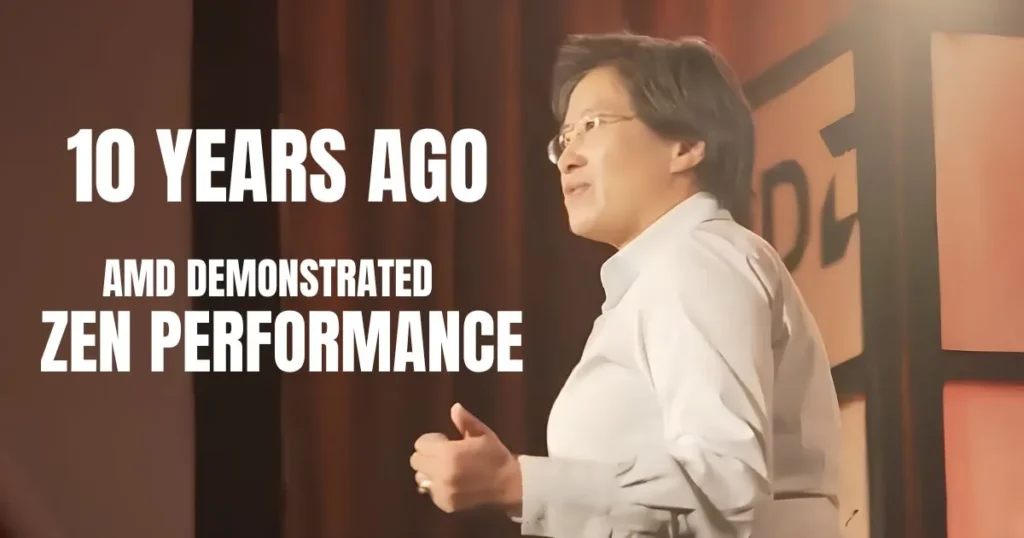
The event, opened by then-newly appointed CEO Dr. Lisa Su, showcased an 8-core, 16-thread “Summit Ridge” engineering sample running at 3.0 GHz. AMD pitted it against an 8-core Intel Broadwell-E processor—specifically, the Core i7-6900K—also locked to 3.0 GHz. The benchmark? A multi-threaded Blender rendering workload.
The result was a milestone: the Zen engineering sample completed the render slightly faster than the Intel chip. It was a narrow victory, but it was a victory nonetheless—and after years of Bulldozer-derived designs struggling to keep up, it sent a clear signal that AMD was back in the game.
The 40% IPC Promise
Zen had already been announced a year earlier, at AMD’s Financial Analyst Day on May 6, 2015, where the company targeted a 40% increase in instructions per clock over its previous architecture. The August 2016 event was the first time AMD could demonstrate that claim in real-world performance.
The architecture was a clean-sheet design, featuring a new cache hierarchy, improved branch prediction, and simultaneous multithreading (SMT). These advances would allow Zen to scale from fanless 2-in-1s to high-performance servers.
Naples: The Server Beast
The event also featured the first public demonstration of AMD’s upcoming 32-core, 64-thread “Naples” server processor, running in a dual-processor system. Naples would later become the foundation of AMD’s first EPYC generation, marking the company’s re-entry into the data center market.
The Road to Ryzen
Summit Ridge would reach desktops in March 2017 as the Ryzen 7 1800X, 1700X, and 1700. The first high-performance 8-core, 16-thread Zen processor was confirmed for an early 2017 release.
Also, Read
- GeForce RTX 5060 Ti 16GB Reaches $780 on Newegg, Crosses RTX 5070 Price in UK
- GIGABYTE AORUS RTX 5090 INFINITY Lands in Europe for an Absurd €6,194
- Ryzen 7 7800X3D Burns and Swells on Updated MSI X870 Motherboard—Even with Latest BIOS
A Decade of Transformation
Ten years later, the CPU market has been transformed. AMD now competes with Intel across desktop, mobile, and server platforms. But this year’s Computex and the July Advancing AI event focused Zen 6 announcements squarely on EPYC and data-center products, with little new information for consumer platforms. Another change: Lisa Su now takes a smaller role in consumer hardware presentations, which are often led by other AMD executives.
The August 2016 event was the moment AMD proved it could compete again. Ten years on, that moment still resonates.
Source: 3DCenter_org, amd