The RTX 5090 Is No Longer a Gaming Card
When NVIDIA launched the GeForce RTX 5090 with a $2,000 MSRP, gamers expected a premium flagship. What they got was a card that quickly became nearly impossible to find at anything close to that price. In the US, the cheapest models have recently reached around $5,000, while European pricing has crossed €5,200. Now, new pictures offer a clear explanation for where much of that supply is going.
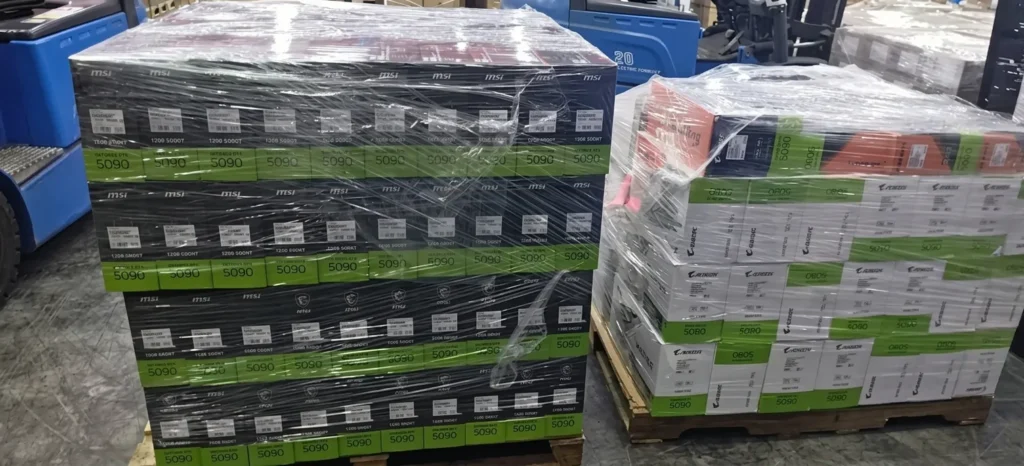
Images posted by HKEPC, reportedly taken at companies assembling AI servers, show pallets stacked with brand-new retail GeForce RTX 5090 graphics cards. These are not professional RTX PRO 6000 cards or dedicated data center accelerators. They are the same gaming GPUs that NVIDIA markets to PC enthusiasts, waiting to be unpacked and installed into multi-GPU AI systems.
A Familiar Story with a New Workload
For anyone who lived through the cryptocurrency mining boom, this scene feels eerily familiar. During that era, mining companies bought GeForce cards in bulk while gamers struggled to find them at normal prices. NVIDIA eventually responded with Lite Hash Rate (LHR) versions of several RTX 30 series cards, which reduced Ethereum mining performance while leaving gaming performance unchanged. The restriction was eventually bypassed, but for nearly a year it made LHR models less attractive to large mining operations.
Now, the workload has shifted from crypto to AI, but the result for gamers is the same. We previously reported on a Vietnamese system builder installing seven RTX 5090 cards into custom AI servers back in April 2025. The trend has only accelerated since then.
NVIDIA Knows How to Limit AI Performance—But Won’t
Interestingly, NVIDIA has already demonstrated that it can reduce a GeForce card’s AI performance while preserving its gaming capabilities. The RTX 5090 D, a variant created for the Chinese market to comply with export restrictions, offers 2,375 AI TOPS compared to 3,352 AI TOPS for the standard RTX 5090. NVIDIA also restricted multi-GPU operation on that model.
In other words, the company knows how to make a GeForce card less attractive for AI workloads without crippling its gaming performance. Yet it has done nothing to prevent these cards from being sold by the pallet, even in China. The bulk sales continue, and NVIDIA appears unwilling to intervene.
Also, Read
- AMD Reportedly Prepares Ryzen 5 7500: 6-Core Zen 4 CPU with Integrated Graphics for AM5
- AMD RDNA 5 Reportedly Targets 3.1 to 3.4 GHz GPU Clocks, Up to 14% Above RX 9070 XT
- AMD Confirms Two Zen 6 Families for AM5: Olympic Ridge CPUs and Medusa1 APUs
Why NVIDIA Won’t Act
The reason is simple: NVIDIA is deeply invested in promoting AI across every part of its business. The company’s leadership has made AI the centerpiece of its strategy, and restricting the sale of GeForce cards to AI firms would run counter to that mission. While NVIDIA could impose stricter rules on bulk sales through board partners and distributors—each card has a serial number, making it easy to track—there is no indication that the company intends to do so.
At the end of the day, the RTX 5090 has become a victim of its own success. It is no longer a gaming card in practice, even if it remains one on paper. For gamers, the message is clear: if you want flagship performance, you’ll have to compete with companies that buy GPUs by the pallet.