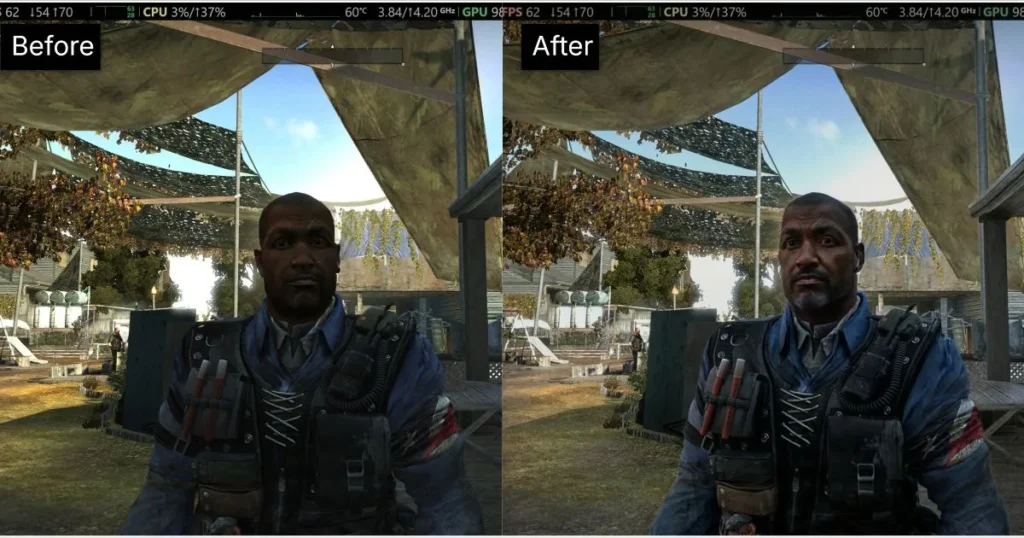
DLSS 5 just became a whole lot easier to run. Borderless Gaming, a paid tool available on Steam, has added support for an unofficial implementation of NVIDIA’s DLSS 5 Neural Rendering. Unlike the many DLSS 5 experiments we’ve covered over the past month, this method doesn’t require replacing game DLLs, modifying game files, or installing a game-specific mod. The effect is downloaded separately from GitHub and loaded through Borderless Gaming’s existing BGFX scaling system.
What Borderless Gaming Brings to the Table
The developer is making it clear that Neural Rendering itself is not bundled with the Borderless Gaming update. Users must install the shader separately if they want it. Once installed, the effect exposes a range of adjustable controls, including strength, lighting, structure, style, and processing resolution. This gives players a surprising amount of control over how the neural rendering is applied to their game.
The developer says he spent considerable time quantizing the model, changing how it runs, and removing bottlenecks in the network. Instead of forwarding requests through NVIDIA’s DLLs, the model runs directly through BGFX. According to the developer, even a GeForce RTX 3090 can target around 30 FPS, although performance will naturally depend on the game and its settings. The implementation also uses experimental shader technology, with more performance expected as Shader Mode 6.10 support improves in drivers.
Why This Matters
This is another significant step beyond the DLSS 5 experiments we’ve already covered on older GeForce cards, Radeon GPUs, and even Apple Silicon. NVIDIA officially supports DLSS 5 Neural Rendering on the GeForce RTX 50 series, and the company has said it plans to work on RTX 40 series support after further RTX 50 optimization.
NVIDIA’s implementation is integrated into the game pipeline and uses engine data including the rendered frame and motion vectors. This means the Borderless Gaming effect should not be confused with native game support. It’s a separate, community-driven approach that sits outside the official NVIDIA ecosystem.
The Gray Area of DLSS 5 Modding
We are entering something of a gray area with these projects. Modders are no longer simply enabling a hidden switch or moving NVIDIA DLLs between games. Developers are now quantizing and adapting the Neural Rendering model for different software paths and hardware. There’s a hope that NVIDIA won’t start taking these projects down, and so far nothing suggests they might. In fact, such mods are working in NVIDIA’s favor by popularizing the technology and giving gamers more options since DLSS 5 is officially limited to one game and one GPU architecture.
The Borderless Gaming Update
The update bringing DLSS 5 Neural Rendering support also includes a range of other improvements. The Windows effects editor has been redesigned, with available effects, effect order, and settings now together in one view. Parameter controls have been improved with clearer descriptions, labeled slider steps, and editable values. Crashes when adding effects to presets have been fixed. Clearer errors now appear when an effect requires hardware features your system doesn’t support. DirectX 12 effects can be combined with existing effects in the same preset.
Performance improvements include better BGFX performance, particularly on Steam Deck and other supported Vulkan hardware, reduced unnecessary rendering work, and improved scaling performance at higher resolutions. Expensive resolution changes are now debounced so dragging a slider doesn’t rebuild the effect repeatedly. Desktop Duplication initialization and graphics-adapter selection issues have been fixed, as have Vulkan layer startup crashes affecting some Linux games. NVIDIA and AMD low-latency integration has been added for supported Vulkan configurations.
Finally, Windows overlay input handling has been fixed: opening the panel releases cursor confinement, stops panel clicks from refocusing the game, and clears held input when closing.
Also, Read
- RTX 5090 Prices Soar to $5,000 as AI Firms Buy Gaming GPUs by the Pallet
- ASRock PSU Thermal Protection Fails to Prevent Melted 16-Pin Cable on $16,000 RTX PRO 6000 GPU
- AMD Releases Ryzen 5 5500F 10 Years After AM4 Arrived
The Bottom Line
For PC gamers eager to experiment with DLSS 5 Neural Rendering without waiting for official support on their hardware, Borderless Gaming offers an intriguing new path. It’s not a native implementation, and it comes with its own performance considerations, but it’s another example of the modding community pushing technology forward in ways that benefit players.
Source: Borderless Gaming