The RTX 5090 Meets Its Match: 6K Resolution
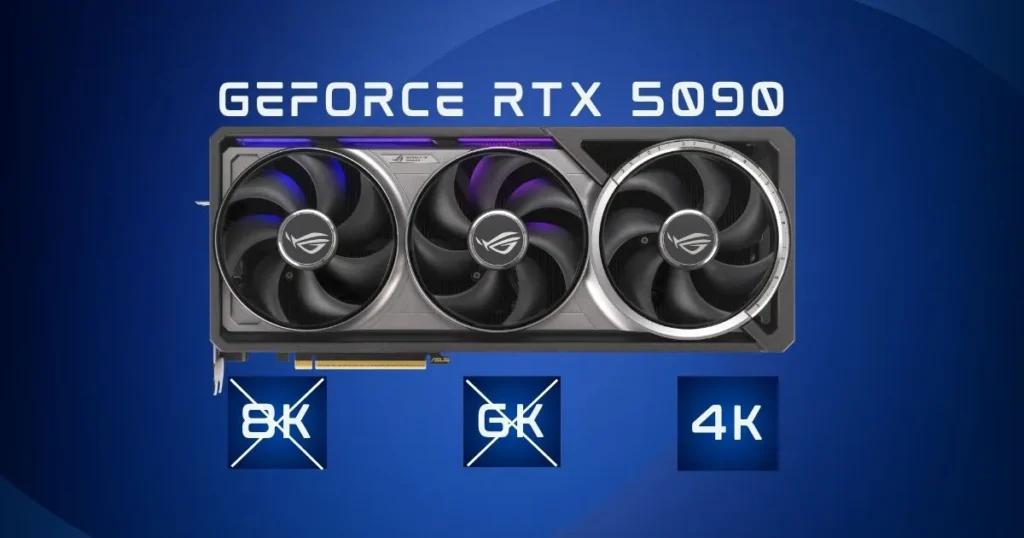
NVIDIA’s GeForce RTX 5090 is currently the fastest gaming GPU on the market. But the arrival of 6K gaming monitors is already pushing it below 60 FPS in demanding games. New testing on Samsung’s 6144×3456 Odyssey G8 G80HS shows just how much performance is lost when moving from 4K to 6K.
6K Has 2.6 Times More Pixels
Samsung’s 32-inch Odyssey G8 G80HS runs at 6144×3456 and 165Hz. This works out to 21.2 million pixels compared with 8.3 million at 3840×2160—a 2.6x increase. For context, Samsung also offers a 3072×1728 mode at 330Hz.
Cyberpunk 2077: 42 FPS at 6K
Cyberpunk 2077 shows just how demanding native 6K output can be. With the Ray Tracing Overdrive preset and DLSS Performance, the RTX 5090 averaged 42 FPS with a 36 FPS 1% low. The same settings at 4K produced 86 FPS and a 68 FPS 1% low. That’s a drop of over 50% in average frame rate.
Disabling ray tracing and using the Ultra preset increased 6K performance to 72 FPS—still below the 90+ FPS many gamers consider smooth, and a significant reduction from 4K performance.
RTX 5070 Ti at 6K: Even Worse
The RTX 5070 Ti averaged only 20 FPS at 6K with Ray Tracing Overdrive and DLSS Performance. Switching to Ultra without ray tracing raised this to 39 FPS. At 4K, the same configurations reached 45 and 90 FPS respectively. The testing suggests settings reductions are required for 6K gaming even before considering the RTX 5070 Ti.
Other Games Tell the Same Story
The pattern continues in other recent titles:
| Game | Settings | RTX 5090 6K FPS |
|---|---|---|
| Crimson Desert | Max settings + Ray Reconstruction | Below 30 FPS |
| Doom: The Dark Ages | Path tracing | 43 FPS |
| Battlefield 6 | Max preset | 77 FPS |
| Battlefield 6 | Low preset + DLSS Performance | ~120 FPS |
To reach roughly 120 FPS in Battlefield 6, the Low preset with DLSS Performance was required—a significant visual compromise.
The 8K Parallel
This brings back memories of NVIDIA’s awkward push to promote DLSS and 8K gaming just before the RTX 3090 launched. Gamers had different problems at the time, including the cryptocurrency mining boom that was about to turn Ampere into the first GeForce generation with widespread pricing far above MSRP.
The RTX 5090 is clearly not ready for 6K gaming—at least not without DLSS and often with ray tracing disabled. Looking at the RTX 5070 Ti results, 6K will not become a focus for display makers for quite some time.
So if you ever wondered what happened to NVIDIA’s 8K marketing push, it looks like even recent improvements in upscaling have not helped GPU performance keep pace with the growing pixel count. The 2020 8K push reminds me of the virtual reality push from the 2015 era—it just never really kicked off despite what GPU companies tried to sell us.
Also, Read
- GPU Market Evolves Backwards as Modded RTX 3080 20GB Cards Return as Cheaper Gaming Alternatives
- Intel Flips the Script: Nova Lake’s New CPU Core Will Debut on Desktop Before Xeon
- Intel Says LGA 1700 Is Still a Good Socket, Raptor Lake to Stay “for Years to Come”
The Bottom Line
The RTX 5090 is the fastest GPU money can buy, but even it isn’t ready for 6K gaming without significant compromises. If you’re considering a 6K monitor, be prepared to either drop settings substantially or accept sub-60 FPS frame rates in demanding titles. The industry’s push toward ultra-high resolutions may be outpacing what even the most powerful consumer GPUs can deliver.
Source: techspot