AMD Extends Server Roadmap to 2030 with Zen 7 and Zen 8
While the tech world was focused on the launch of AMD’s 256-core EPYC “Venice” processors, the company was already looking far into the future. At its Advancing AI 2026 event, AMD CEO Lisa Su pulled back the curtain on an ambitious roadmap that extends through the end of the decade, confirming the next two generations of its Zen CPU architecture.
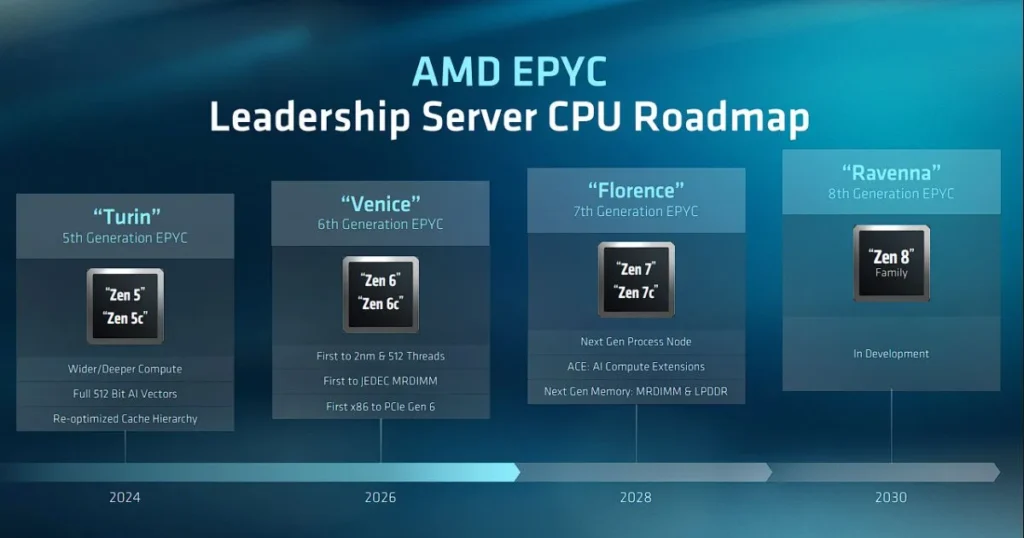
The roadmap confirms that AMD is maintaining a predictable cadence for its data center platforms, with new EPYC generations arriving every two years.
2028: EPYC “Florence” Brings Zen 7 and a New AI Focus
The seventh-generation EPYC family, codenamed “Florence,” is scheduled for a 2028 release. At its heart will be the Zen 7 microarchitecture, which will be available in both standard and compute-optimized (Zen 7c) variants.
According to AMD, Florence will be built on a “next-generation process node,” which industry observers expect to be a sub-2nm technology such as TSMC’s A16 or A14. The platform will introduce several key advancements:
- ACE AI Compute Extensions: These new extensions will equip Zen 7 with enhanced AI capabilities, making it a more powerful host for AI workloads.
- Next-Gen Memory Support: Florence will be the first EPYC family to support next-generation memory standards like MRDIMM and LPDDR, potentially paving the way for DDR6 adoption.
- Platform Variants: The Florence family will include multiple variants, such as “Ferrara” for AI host nodes and “Fidenza” for agentic AI sandboxes, allowing AMD to offer purpose-built CPUs for a wider range of applications.
2030: EPYC “Ravenna” and the Zen 8 Architecture
And the planning doesn’t stop in 2028. AMD confirmed it is already “deep in development” of “Ravenna,” the 8th Generation EPYC family built on the Zen 8 architecture. Scheduled for a 2030 release, Ravenna represents AMD’s long-term commitment to the server market. While details are scarce, its very existence confirms that Zen 8 is already in the works.
Instinct GPU Roadmap: Annual Cadence Through 2028
On the GPU front, AMD is maintaining an aggressive annual release cadence for its Instinct accelerators.
- 2027: Instinct MI500. The MI500 series will introduce the CDNA 6 architecture and feature next-generation HBM4e memory. It will also include new copper and optical interconnects, enabling larger scale-up domains. AMD claims MI500 will deliver the largest generational leap in Instinct history. The MI500 will anchor the Helios 500 rack-scale platform.
- 2028: Instinct MI600. Following in 2028, the MI600 series, based on a “CDNA Next” architecture, is already deep in development. It will power the Helios 600 platform, paired with EPYC Ferrara processors.
Also, Read
- Japanese Amazon Buyer Orders One Core i5-14400, Receives Five—and Returns the Extras
- AMD Ryzen 7 7700X3D Drops to $279.99 Just Two Days After Launch
- AMD Ryzen 7 7700X3D Launches as Newegg Exclusive in the US—$481 Bundle Includes B650E Motherboard and 16GB DDR5
A Clear Roadmap Amidst Uncertainty
AMD’s decision to lay out its server and AI accelerator roadmap through 2030 provides a clear signal to enterprise customers and investors. As highlighted by some observers, this level of transparency for data-center products contrasts with the relative silence on consumer Radeon GPU timelines. For now, the focus remains on the AI gold rush, and AMD is signaling it will be there with competitive silicon for the long haul.
Source: AMD