A Cautionary Tale: RTX 5090 Owner Did Everything Right, Yet the 12V‑2×6 Connector Still Melted
Another report of a melted 16‑pin power connector has surfaced on Reddit, but this one comes with a frustrating twist: the owner was meticulous about maintenance. The user, running an MSI GeForce RTX 5090 SUPRIM with a Corsair RM1000x power supply and Corsair’s official Type 4 12V‑2×6 cable, says he inspected the connector every three months and pushed it in monthly to ensure full seating.
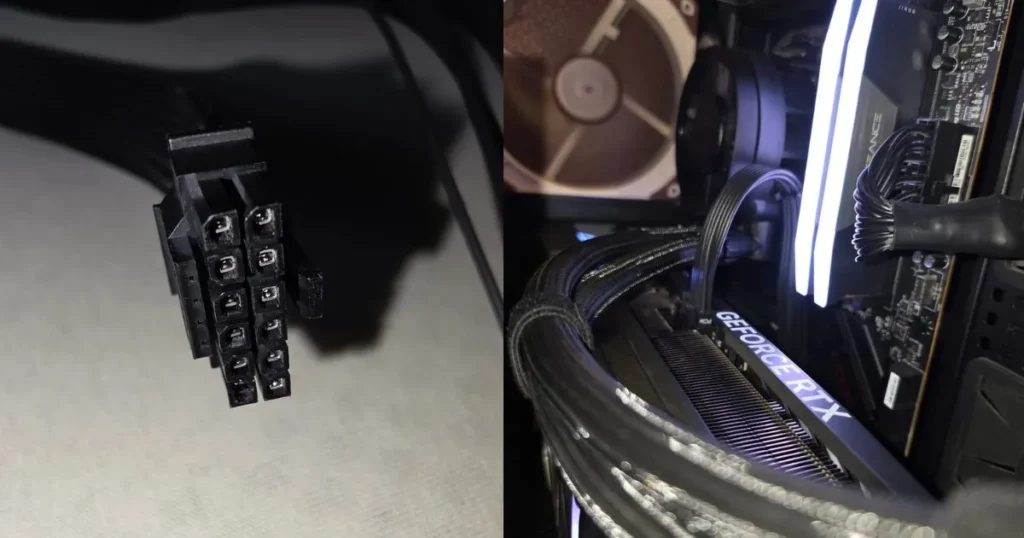
The card was vertically mounted, and the user claims there was 7 to 9 cm of straight cable clearance before any bend – well above the recommended minimum. Despite these precautions, after a few weeks of gaming, he found a melted cable end and blackening inside the GPU’s power socket.
The Problem with Routine Checks
During the original RTX 4090 12VHPWR melting reports, many users began unplugging their cables regularly to check for damage. While this can help spot early discoloration, repeated unplugging and reseating can wear down the terminals. Corsair and Seasoniс both rate their 12VHPWR/12V‑2×6 connectors for 30 mating cycles. The user’s quarterly inspections used up only a few of those cycles (he likely still had 24+ left), so wear is unlikely to be the cause – but the incident shows that even careful handling doesn’t guarantee safety.
The owner also had a sensor panel monitoring telemetry data in real time, but that only showed PSU and GPU readings. There was no direct data from the connector itself, which is a blind spot in most systems.
A Call for Built‑in Monitoring
This case adds to the growing evidence that the 16‑pin connector design is vulnerable, even under seemingly ideal conditions. Active monitoring solutions are starting to appear: ASUS offers Power Detector+ on selected ROG Astral cards, and Cooler Master has introduced GPU Shield for 12V‑2×6 monitoring on its new MWE Gold V4 power supplies. These features can warn users of abnormal current distribution or rising temperatures at the connector.
If NVIDIA’s next GPU generation retains the same compact power connector, built‑in monitoring should arguably become standard – not a premium add‑on. Until then, even the most diligent users remain at risk.
Also, Read
- NVIDIA GeForce RTX 50 SUPER Refresh ‘Back on Track’, RTX 5060 12GB Reportedly Planned
- AMD Hints at Ryzen 5 9600X3D Launch Later This Year: Six-Core Zen 5 with 3D V‑Cache
- AMD FSR 4.1 May Skip RDNA 3.5 Integrated Graphics, Leaving Laptops and Handhelds in Limbo
What You Can Do
For current RTX 4090/5090 owners:
- Use a native 12V‑2×6 cable from a quality ATX 3.1 PSU instead of adapters.
- Ensure the connector is fully seated and avoid frequent reseating.
- Consider aftermarket cables with thermal probes or invest in a PSU/GPU that offers connector monitoring.
- Watch for unexplained system crashes or black screens – they may precede a meltdown.
The Reddit user’s story is a sobering reminder: the 16‑pin connector doesn’t just fail from neglect; it can fail despite perfectionism. The industry needs a more robust solution.