Microsoft has officially rolled out Shader Execution Reordering (SER) as part of DirectX Raytracing (DXR), marking a significant milestone for real-time graphics optimization. The technology, now integrated into Shader Model 6.9, promises to tackle one of ray tracing’s most persistent performance bottlenecks: divergent shader execution.
What Is SER and Why Does It Matter?
Ray tracing workloads are inherently unpredictable. As rays bounce through a scene, they encounter different materials, hit or miss geometry, and trigger vastly different shading calculations. This randomness—called “divergence”—forces GPU threads to wait for each other, wasting parallel processing power.
SER solves this by adding HLSL primitives that allow shader code to signal where coherence exists across rays. The GPU can then reorder and group similar work, executing it far more efficiently. As Microsoft explains in their developer blog, SER enables “application-controlled reordering of work across the GPU for improved execution and data coherence”.
Stunning Results in Microsoft’s Demo
To demonstrate SER’s potential, Microsoft created the D3D12RaytracingHelloShaderExecutionReordering sample—a deliberately artificial test that maximizes divergence to show sorting benefits. The results, shared in a recent DirectX Developer Blog post, are striking :
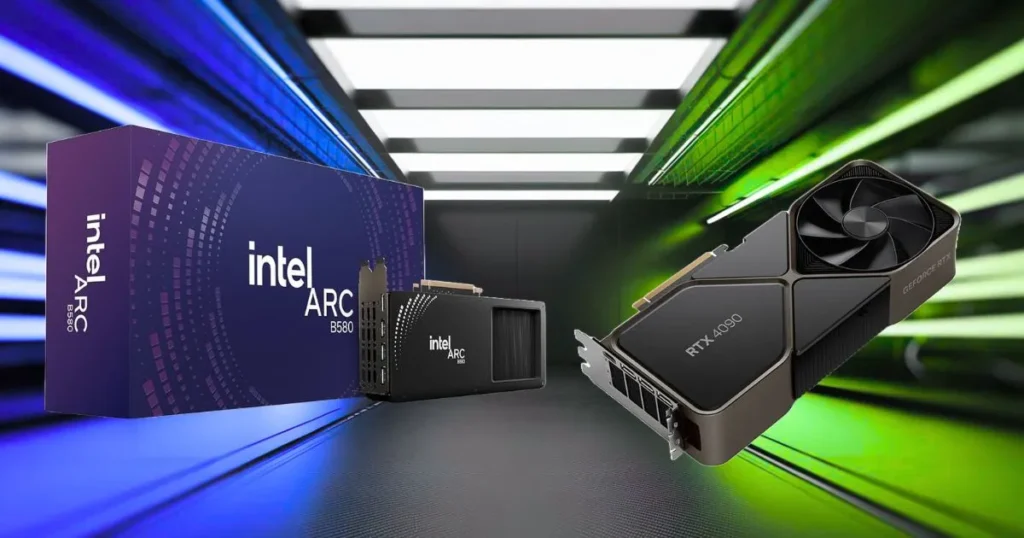
- NVIDIA GeForce RTX 4090: 40% higher frame rate with SER enabled versus without
- Intel Arc B-Series GPUs: Up to 90% higher performance across multiple configurations
These figures come from Microsoft’s controlled test environment, not actual games. The sample draws a full-screen quad and applies artificial “light” and “heavy” shading work in vertical bands to force divergence, then measures how effectively SER groups similar threads.
Beyond the Synthetic Demo: Real-World Promise
While the demo is synthetic, the technology has already shown real-world potential. At GDC 2025, Remedy Entertainment demonstrated that combining SER with Opacity Micromaps (OMMs) reduced ray tracing costs by roughly one-third in Alan Wake 2. This suggests that when properly integrated, SER can deliver tangible benefits in shipping games.
Also, Read
- Qualcomm Hits Pause: No Windows Gaming Handheld Announcements at GDC 2026
- RTX 5090 Burns Even at 500W – User’s Power Cap Fails to Prevent Melted Adapter
- Intel Core Ultra 400 “Nova Lake-S” Desktop Reportedly Arrives at CES 2027 Alongside AMD Zen 6
Hardware Support and Availability
SER is a required feature of Shader Model 6.9, meaning drivers must accept shader code using SER. However, actual performance acceleration depends on hardware support.
Current compatibility includes:
- NVIDIA: All GeForce RTX 40 and 50 Series GPUs accelerate SER. RTX 20 and 30 Series support SER functionally (the reorder step is a no-op, but there’s no performance penalty).
- Intel: Support is available for Intel Arc B-Series Graphics and Intel Core Ultra Processors (Series 2) with appropriate developer preview drivers.
- AMD: Preview driver support is now available.
Microsoft cautions that these figures reflect “a specific demo and its configuration, not a shipped game benchmark”. Still, the official status of SER means developers can now confidently integrate the technology into commercial projects. Future games with SER support could see widespread ray tracing efficiency gains.
Source: Microsoft