“I Did Everything Right”: RTX 5090 Owner’s 500W Power Cap Still Ends in Melted Connector
The saga of melting 16-pin power connectors on NVIDIA’s flagship graphics cards has taken a troubling new turn. A user on the Taiwanese forum Mobile01 reports that their Gigabyte RTX 5090 AORUS MASTER ICE suffered a burned power adapter despite taking what many would consider prudent precautions: limiting the card’s power draw to 500W and locking voltage at 0.9V.
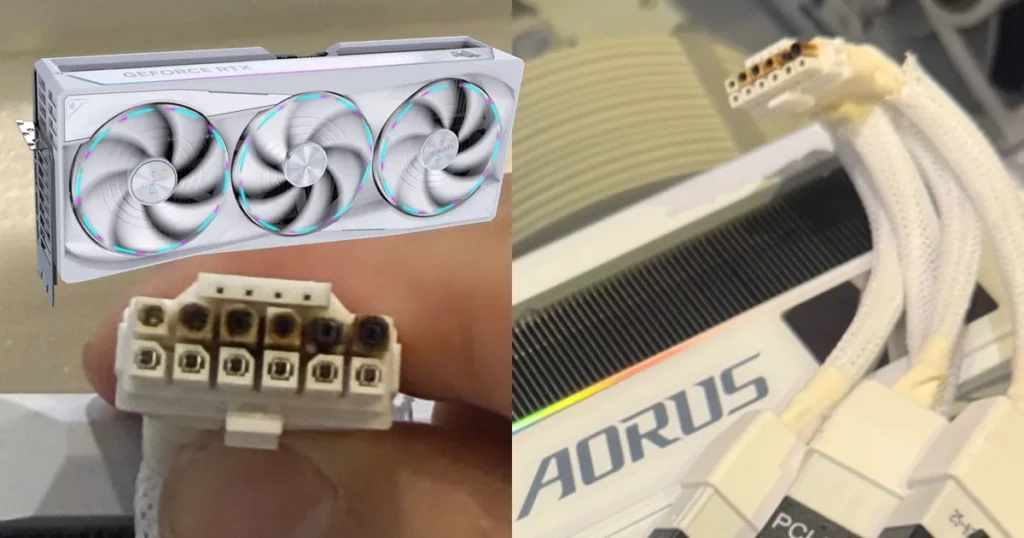
The user, posting under the handle “sanetidaay,” explained that the system began crashing during gaming sessions after approximately seven months of use. Upon inspection, the 16-pin adapter bundled with the card showed clear signs of melting, with the top row of pins completely blackened while the bottom row remained intact.
What makes this case particularly concerning is the user’s proactive approach to risk mitigation. Aware of the growing number of 12V-2×6 connector failure reports, they had followed online guidance and used MSI Afterburner to cap the graphics card at 500W—75W below the RTX 5090’s default 575W power limit. They also locked voltage at 0.9V and used only the original cables included with the card.
“I remember I followed an online tutorial and used Afterburner to limit the graphics card to 500W,” the user wrote. Despite these efforts, the connector still failed.
Not a Simple Power Issue
This case challenges the assumption that keeping power draw safely below the 600W rated maximum of the 12V-2×6 connector guarantees safety. Experts point to a more nuanced problem: current distribution across individual pins.
Technical analysis suggests that when contact is imperfect, the load can become concentrated on fewer pins than intended. Each pin in the 16-pin configuration is rated for a maximum of 9.5A. Under ideal conditions with perfect contact, power is distributed evenly. But if some pins make poor contact, the remaining pins must carry disproportionately higher current.
In extreme cases, a single pin could be forced to carry over 40A—more than four times its rated capacity. This generates localized heating that can melt the connector even when total system power remains well within specifications.
The user’s observation that only the top row of pins melted while the bottom row appeared normal aligns with this theory of imbalanced current distribution.
Official Statistics Tell a Different Story
Despite the growing number of anecdotal reports flooding forums, official failure rates remain surprisingly low. INNO3D, in a response to a user inquiry on January 12, 2026, shared data from its European RMA center in the Netherlands. According to the company, fewer than 15 cases of melted connectors have been recorded across both RTX 4090 and RTX 5090 cards throughout the entire European Union.
A company representative noted that service centers encounter mechanical damage from user error far more frequently than power supply defects, suggesting that the scale of the issue may be exaggerated relative to the installed base.
The Human Cost of “Statistical Noise”
For the individual user, however, statistics offer little comfort. Sanetidaay now faces an uncertain warranty claim, concerned about possible internal damage to the GPU, power supply, or other components. The card itself showed no visible damage at the connector interface, leaving open the question of whether the graphics card sustained hidden harm.
The user has indicated they will push back aggressively if the damage is blamed on “user error,” pointing to the many similar cases documented online as evidence of a systemic issue.
Design Flaws and Mitigation
The 12V-2×6 connector was introduced as an improvement over the earlier 12VHPWR standard, with shortened sense pins designed to ensure the connector is fully seated before power is delivered. However, critics argue that the fundamental architecture remains vulnerable to the same failure modes.
Unlike previous generations that included per-pin current limiting, NVIDIA’s RTX 40 and 50 series cards eliminated this feature. When contact is poor, the system cannot balance load across pins or automatically shut down.
Also, Read
- GPU Market Distortion – RTX 5060 Ti 16GB Now Costs Nearly as Much as an RTX 5070
- NVIDIA RTX 5090 Ti Reportedly Developing New Ultimate GPU – A 5090 Ti or Titan for Late 2026
- NVIDIA’s RTX 50 SUPER Refresh Delayed, Next-Gen RTX 60 May Be Pushed to 2028
For users seeking to minimize risk, experts recommend:
- Using native 16-pin cables from ATX 3.1 compliant power supplies rather than adapter cables
- Ensuring the connector is fully seated with no gap visible
- Avoiding sharp bends within 35mm of the connector
- Securing the cable to prevent movement or vibration from stressing the connection
The Path Forward
As the industry watches these cases accumulate, pressure mounts on NVIDIA and its board partners to address the underlying connector concerns. Some have called for a return to multiple traditional PCIe power connectors on flagship cards, while others advocate for a complete redesign of the 12V-2×6 standard.
For now, users investing in RTX 5090-class graphics cards must weigh the performance benefits against a small but non-zero risk of connector failure—a risk that, as this case demonstrates, cannot be fully mitigated even through careful power management.
Source: mobile01, unikoshardware