“Many Will Die”: Phison CEO Predicts Consumer Electronics Bloodbath as AI Hoovers Up Memory Supply
A stark warning has emerged from the heart of the semiconductor industry. According to Phison Electronics CEO Chien Cheng Pan, the consumer electronics sector is heading for a brutal reckoning. Speaking on the ChenTalkShow, Pan predicted that many system companies will “go bankrupt or exit product lines” by the end of 2026, driven by an unprecedented AI-fueled shortage of DRAM and NAND Flash memory that could last until 2030.
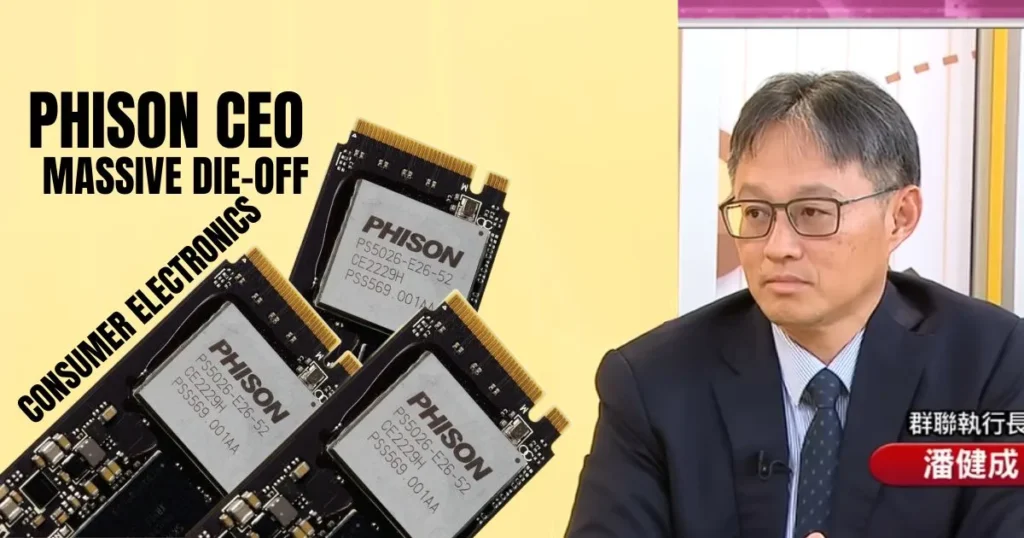
The warning paints a dire picture for manufacturers of smartphones, PCs, televisions, and countless other consumer devices. Pan describes a perfect storm where surging demand from artificial intelligence infrastructure is consuming vast quantities of memory, leaving consumer goods makers fighting over scraps while facing skyrocketing component costs.
A Seller’s Market Demanding Three Years of Prepayment
Pan characterized the current market as overwhelmingly favoring memory suppliers. In a sign of just how tight supplies have become, he claims that some memory vendors are now demanding three years of prepayment from customers to secure allocation. This effectively locks out smaller players who lack the capital to commit to such terms, consolidating supply among the largest and wealthiest buyers.
For those who can still secure memory, the price increases have been staggering. Pan cited the example of 8GB eMMC storage, which rose from approximately $1.50 in early 2025 to around $20 today—a more than tenfold increase. Automotive-grade versions of similar components are approaching $30, and even at those elevated prices, consistent availability remains elusive.
“If you can’t get components, a system maker missing even one part simply can’t keep operating,” Pan explained. This dependency on a single component category means that companies unable to secure memory allocation face complete production shutdowns, regardless of their ability to source every other part.
Why Consumer Devices Are Hit Hardest
The CEO offered a clear explanation for why consumer electronics are bearing the brunt of the shortage while other sectors continue to receive supply. Memory represents a fundamentally different cost proposition across market segments.
For a typical smartphone, memory can account for over 20% of the total bill of materials. For a server, that figure drops to around 5% to 6%. This disparity means that data center operators and cloud providers can readily absorb higher memory prices or even pay premiums to secure allocation. Their margins and business models accommodate the cost.
Consumer device manufacturers operate on thinner margins and serve price-sensitive markets. When memory prices spike, they cannot simply pass the full cost increase to consumers without destroying demand. Consequently, suppliers prioritize the deep-pocketed data center customers, leaving consumer brands to scramble for leftovers.
Pan predicts this dynamic will lead to a reduction of 200 to 250 million smartphone units in annual production, alongside “significant” cuts in PC and television output. For context, a reduction of that magnitude would represent roughly 15% to 20% of the annual global smartphone market.
AI Infrastructure: The Insatiable Hunger
The root cause of this supply crunch, according to Pan, is the explosive growth of artificial intelligence infrastructure. Training and running large language models requires enormous computational resources, and those systems demand commensurate storage.
Pan pointed specifically to NVIDIA’s upcoming Vera Rubin architecture as an example of the scale involved. According to his reading of NVIDIA’s disclosures, each Vera Rubin GPU would be paired with over 20 terabytes of SSD storage. If NVIDIA were to ship 10 million such units, Pan calculates that the SSD requirement alone would consume approximately 20% of global NAND output from the previous year—and that is before accounting for the additional storage needed for the data those systems generate and process.
This single product line from one company threatens to absorb a fifth of the world’s NAND production capacity. When multiplied across the entire AI ecosystem, which includes countless other GPU vendors, cloud providers, and specialized AI hardware companies, the demand becomes virtually insatiable.
A Crisis Extending to 2030
Perhaps most troubling is Pan’s assessment of the timeline. He suggests that the supply-demand imbalance for both DRAM and NAND Flash could persist until 2030. This is not a short-term spike but a structural realignment of the memory market, where AI infrastructure permanently consumes a larger share of output, leaving less available for traditional consumer applications.
Memory manufacturers have limited ability to rapidly expand production. Building new fabrication facilities requires years of lead time and billions in capital investment. Even if construction began today, new capacity would not come online until the end of the decade. In the interim, existing supply must be rationed, and the rationing mechanism favors those willing to pay the most.
Longer Device Lifespans as a Side Effect
One unintended consequence of the shortage, Pan noted, could be extended consumer device lifespans. When new devices become more expensive or harder to obtain, consumers tend to repair and keep their existing products longer. This could shift consumer behavior toward maintenance and upgrades rather than full replacements, potentially reducing electronic waste even as it frustrates upgrade cycles.
Also, Read
- Premium handheld console Shock – AYANEO NEXT 2 Costs Up To $4,299, Weighs 3 Pounds
- ASRock Launches Investigation Amid Reports of Ryzen 9000 CPU Failures on Its Motherboards
- CPU Reliability Report – AMD Ryzen 9000 and Intel Core Ultra 200 Show Nearly Identical Failure Rates
The Bottom Line
For consumers, the Phison CEO’s warning translates into higher prices, reduced choice, and potentially longer waits for new devices in the coming years. For system makers, particularly smaller brands without deep pockets or long-term supply contracts, the outlook is existential. Pan’s prediction of a “massive die-off” by the end of 2026 suggests that the landscape of consumer electronics could look fundamentally different just a few years from now, with fewer players and less variety in the market.
As AI continues its relentless expansion, the competition for memory between data centers and consumer devices has only one winner. The question is how many consumer electronics companies will survive to see the other side.