In a stunning display of market distortion, the NVIDIA GeForce RTX 5070 Ti—a card positioned in the upper-midrange—is now being sold for prices that exceed the official cost of its more powerful sibling. At major US retailers like Best Buy, multiple models of the RTX 5070 Ti are now listed in four-digit territory, crossing the $1,000 mark, a price point that officially belongs to the higher-tier RTX 5080.
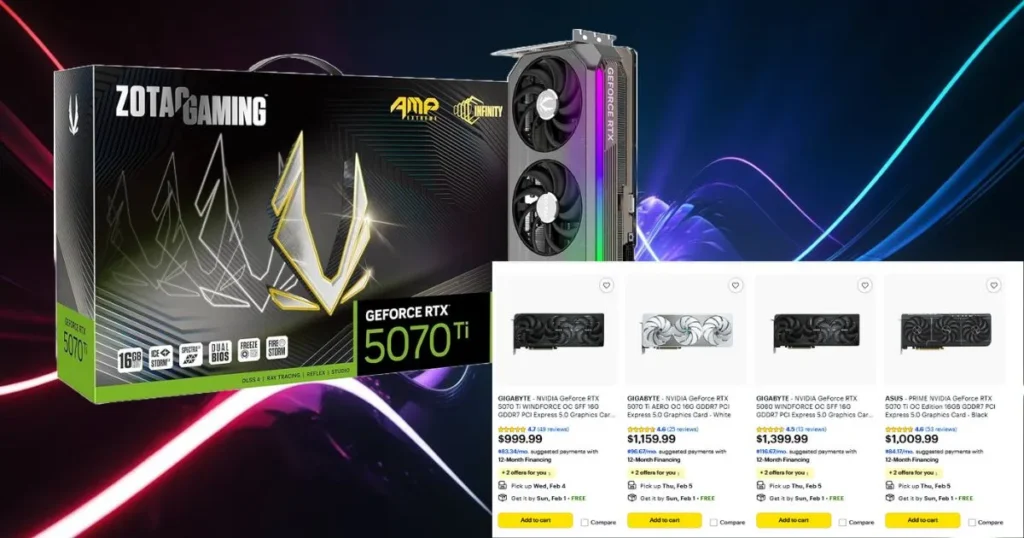
This pricing inversion highlights the severe disconnect between official statements, limited channel supply, and the reality consumers face when trying to buy graphics cards.
Denials vs. Data: The Contradiction Grows
This price surge follows weeks of rumors and contradictory reports. Earlier this year, leaks suggested NVIDIA had paused RTX 5070 Ti production, a claim the company denied. Board partner ASUS initially indicated the card was reaching “end of life” due to supply constraints, then walked that statement back.
However, the retail market is telling a different story. The widespread appearance of $1,000+ price tags for the 5070 Ti is a classic symptom of extreme scarcity. Whether due to official allocation cuts, overwhelming demand, or a combination of both, the result is the same: retailers and third-party sellers are pricing the few available cards at what the market will bear, consequences be damned.
The Price Inversion: A 70-Class Card Outpricing an 80-Class MSRP
The most telling detail is the price comparison. NVIDIA’s official MSRP for the RTX 5080 is $999. The fact that numerous RTX 5070 Ti models are now priced above that figure turns normal product hierarchy upside down. It means consumers are being asked to pay a premium for a less powerful card, simply because it might be one of the few units available.
While a handful of less popular models, like certain MSI Ventus cards, can still be found near $839-$859, they are the exception. The broader trend shows the 5070 Ti has escaped its intended price bracket entirely, pushed upward by the same memory shortages and allocation shifts affecting the entire RTX 50 series.
GPU Price on AMAZON
What This Means for Buyers: A Market of Absurd Choices
This situation forces potential buyers into a frustrating calculus:
- Overpay for the Mid-Range: Purchase an RTX 5070 Ti at a price that was meant for a significantly faster card.
- Hunt for a Phantom MSRP: Try to find an RTX 5080 at or near its $999 MSRP, which is also challenging.
- Abandon the Segment: Look to previous-generation cards or alternatives, accepting lower performance.
Also, Read
- Buyer Allegedly Receives Rocks, Not an RTX 5090, in $3,000 Amazon Resale Order
- AMD Gorgon Halo APU Specs Leak – New Max+ 495 Model to Feature 5.2 GHz Boost, 3.0 GHz GPU
- Intel’s “Big Battlemage” GPU May Debut in Professional Market, Gaming Future Unclear
The soaring price of the 5070 Ti is the clearest possible market signal that supply is not meeting demand. It validates the concerns that sparked the production cut rumors in the first place and demonstrates that official denials do not always translate to healthy inventory on store shelves. For NVIDIA, it risks damaging the value perception of its entire product stack, as consumers grapple with a market where the mid-range no longer exists at a mid-range price.