In an impressive display of technical skill, a Russian hardware modder known as VIK-on has successfully built a fully functional 32GB DDR5 memory stick from salvaged components, achieving performance comparable to high-end retail kits at a fraction of the cost. His DIY project highlights the extreme cost disparities for PC components in some regions and what determined enthusiasts can accomplish.
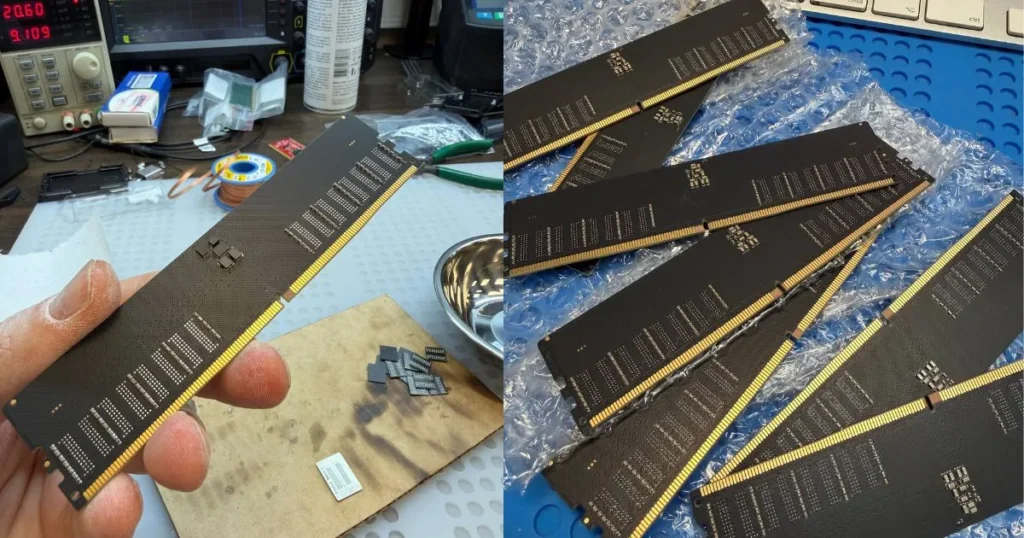
Faced with steep local prices for DDR5 memory, VIK-on engineered a solution from the ground up. The project serves as a fascinating case study in hardware modification, combining physical chip transplantation with firmware hacking to create a viable product.
The DDR5 Memory Build: Sourcing, Assembly, and The Firmware Key
The modder’s process was methodical. He started with the core components: memory chips salvaged from two 16GB laptop SO-DIMM modules. These were purchased for approximately 8,000 rubles each. The chips were then de-soldered and carefully transplanted onto a new, blank DDR5 UDIMM PCB, which cost about 600 rubles. A simple heatsink from AliExpress completed the physical assembly.
The total parts cost reached roughly 17,015 rubles (about $218). However, the true genius of the build lay in the software. To get the module running at high speeds, VIK-on flashed it with the XMP profile firmware from an ADATA AX5U6400C3232G-DCLARWH kit. This allowed his homemade stick to automatically run at a fast DDR5-6400 CL32—a profile identical to that $800 retail kit—without manual tuning.
A Cost-Saving Response to Market Prices
This project was driven by necessity. In the modder’s local market, a comparable 32GB DDR5-6400 memory kit can cost between $423 and $588, with some high-performance kits reaching $800. By sourcing components differently and applying his expertise, he built a functional equivalent for less than a third of that price.
While not “free” memory, it demonstrates how component-level sourcing and technical knowledge can circumvent retail markups, especially in regions with less competitive pricing or availability. VIK-on noted that laptop SO-DIMMs can sometimes be easier to source than desktop sticks, opening this alternative path for the savvy builder.
Also, Read
- AMD Confirms Ryzen 9 9950X3D2 – A 192MB Cache Gaming Powerhouse is Coming
- NVIDIA Unveils DLSS 4.5 – 6X Frame Generation and AI Image Overhaul Launching in 2026
- NVIDIA Unveils Rubin AI Platform: 72-GPU Super Rack, New Vera CPU, and 5x Blackwell Performance
Not for Everyone, But a Testament to Skill
The modder himself acknowledges the complexities. He explored an even cheaper version using 8GB chips but found compatibility issues with different PCB designs. For most users, soldering microscopic memory chips and hacking firmware is far beyond a practical upgrade path.
However, as a proof of concept, it’s remarkably successful. VIK-on reports the module runs stably in games, and he plans to build more and release a full video detailing the process. His project is a powerful reminder of the core DIY spirit in the PC community, where understanding the technology can sometimes be the best tool against high costs.
Source: videocardz