Budget APU, Hidden Compromise: Ryzen AI 400 Series Can’t Feed Modern GPUs
AMD’s newly launched Ryzen AI 400 series desktop processors, the successors to the popular Ryzen 8000G lineup, promise Zen 5 architecture and capable integrated graphics at an attractive price point. But for users who might eventually want to add a discrete graphics card, there is a significant hidden catch that could undermine performance.
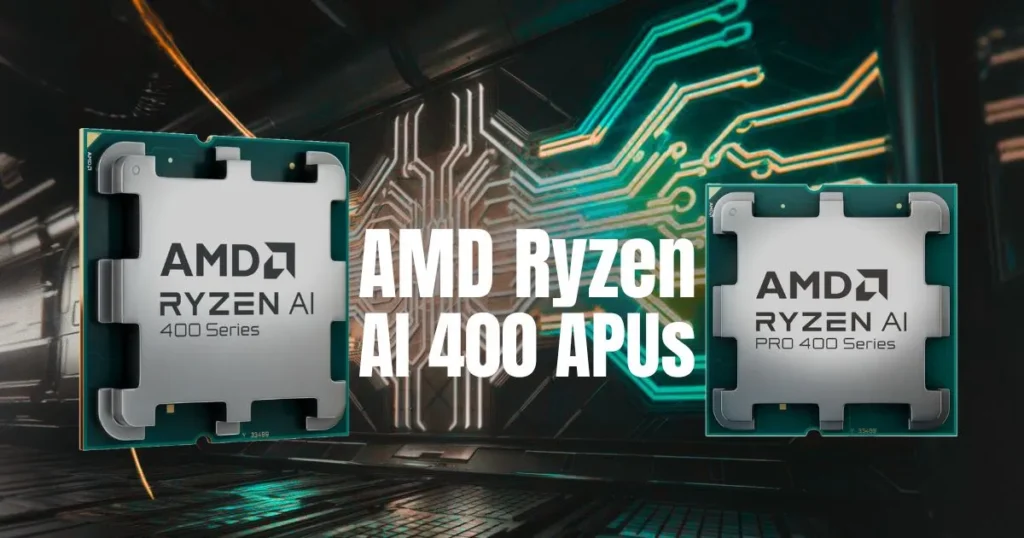
According to detailed specifications published on AMD’s official website and analyzed by multiple hardware outlets, the new Gorgon Point-based APUs offer fewer usable PCIe lanes than their predecessors. This means that even a modern Radeon RX 9000 series graphics card cannot run at its full potential bandwidth when paired with these chips.
The Numbers: 12 Usable Lanes, Not 16
The flagship Ryzen AI 7 450G, along with the Ryzen AI 5 440G, is specified with a total of 16 native PCIe 4.0 lanes. However, on the AM5 platform, four of those lanes are permanently reserved for communication with the motherboard chipset. This leaves just 12 usable lanes for connecting other devices such as graphics cards, NVMe SSDs, and high-speed networking.
The lower-tier Ryzen AI 5 435G is even more constrained, offering only 14 total lanes with just 10 usable after the chipset takes its share.
By comparison, the previous-generation Ryzen 7 8700G offered 20 total PCIe 4.0 lanes, with 16 fully available for expansion. Standard Ryzen 7000 and 9000 desktop processors provide 28 lanes, including PCIe 5.0 support.
What This Means for Graphics Cards
Modern graphics cards, including AMD’s own Radeon RX 9000 series, are designed for 16-lane interfaces. Even the more affordable Radeon RX 9060 XT is specified as a PCIe 5.0 x16 card.
When installed in a system with a Ryzen AI 400 APU, the best-case scenario for a GPU is a connection running at PCIe 4.0 x8. This is because the 12 usable lanes must be shared: installing a single NVMe SSD (which typically consumes four lanes) leaves exactly eight lanes for the graphics card.
Performance Impact: Up to 30% or More
Running a modern GPU at PCIe 4.0 x8 effectively limits its bandwidth to that of a PCIe 3.0 x16 connection. While conventional wisdom once held that this was sufficient for gaming, recent testing tells a different story.
Hardware Unboxed has documented that in certain games and settings, the bandwidth reduction can lead to a performance loss exceeding 30%. The impact is particularly pronounced on graphics cards with smaller frame buffers, such as 8GB versions of the RX 9060 XT or RTX 5060 Ti, where the combination of reduced bandwidth and limited VRAM can cause significant stuttering, frame drops, and texture issues.
Independent testing of high-end cards like the RTX 5090 has confirmed that restricting PCIe bandwidth—even to PCIe 4.0 x8—can result in measurable performance degradation in both gaming and professional applications. In DaVinci Resolve, for example, severe bandwidth limitations have been shown to cut performance nearly in half.
Also, Read
- Microsoft: Shader Execution Reordering delivers up to 90% higher performance on Intel Arc B-Series in tech demo
- Qualcomm Hits Pause: No Windows Gaming Handheld Announcements at GDC 2026
- Go Big or Go Home – LG’s Massive 52-Inch 5K2K 240Hz Monitor is Now Available for Pre-Order
Why the Reduction?
The Ryzen AI 400 series for desktops is based on the smaller “Krackan Point” die rather than the full-featured “Strix Point” silicon used in higher-end mobile variants. These chips are fundamentally designed as APUs—processors with a primary mission of delivering capable integrated graphics without needing a discrete GPU.
The Ryzen AI 7 450G’s integrated Radeon 860M graphics (8 CUs) is perfectly adequate for everyday computing, media consumption, and even lighter gaming without a separate card. The compromise in PCIe lanes appears to be a deliberate design trade-off to optimize die space and power characteristics for that use case.
The Bottom Line for Buyers
For users building a system intended to rely solely on integrated graphics, the Ryzen AI 400 series remains a perfectly viable option. The Zen 5 cores and modern RDNA 3.5 iGPU will handle office work, browsing, and streaming with ease.
However, the new APUs are poor choices for budget gaming builds that plan to add a discrete GPU. If you anticipate ever installing a graphics card—particularly a current-generation Radeon RX 9000 or GeForce RTX 50 series card—the PCIe lane limitation will become a bottleneck that leaves performance on the table. In such scenarios, a standard Ryzen 7000 or 9000 processor, or even a previous-generation Ryzen 8000G APU with its full 16-lane allocation, is a more sensible foundation.
As always, checking the full specifications on AMD’s official website before purchasing is the surest way to avoid an unwelcome surprise down the road.
Source: AMD