The persistent rise in memory chip costs is beginning to directly dictate which graphics cards manufacturers choose to build. According to a new industry report, AMD and its board partners are shifting their production focus toward the Radeon RX 9070 XT, potentially at the expense of the standard Radeon RX 9070. The reason is pure economics: when the cost of memory is high, building the more expensive, higher-margin model makes more business sense.
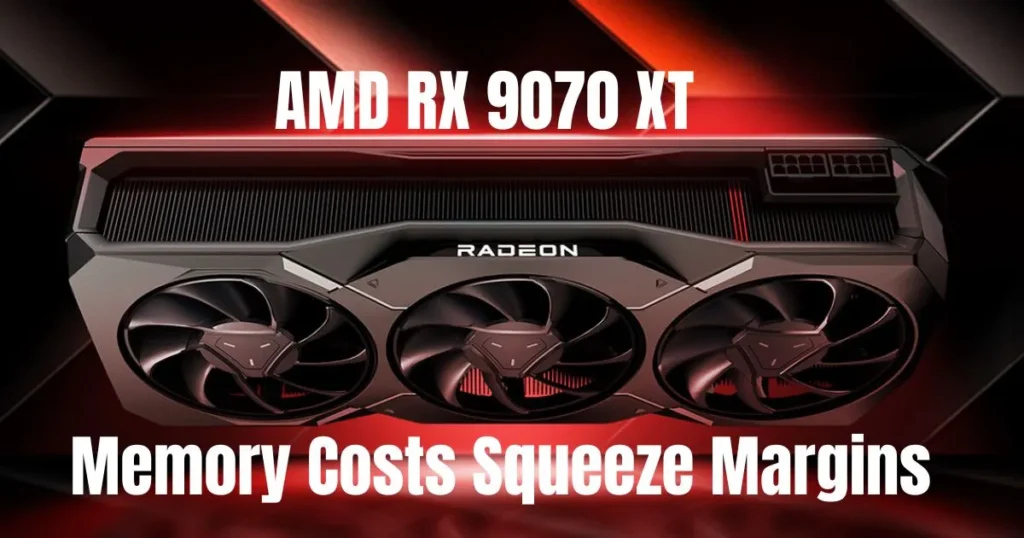
This move highlights how component-level pricing pressures can reshape product lineups, steering the market away from certain SKUs even if they are not officially discontinued.
The Memory Math: Identical Cost, Different Price Tag
The core of the issue lies in the bill of materials. As noted by the report from PROHARDVER, both the RX 9070 and the faster RX 9070 XT are built with 16GB of GDDR6 memory, typically requiring eight physical memory chips per card. When memory prices increase, the cost added to each card is roughly the same for both models.
However, the RX 9070 has a lower Manufacturer’s Suggested Retail Price (MSRP)—$549 vs. $599 for the XT. With a nearly identical build cost but a lower selling price, the profit margin on the non-XT model gets squeezed much harder. For board partners deciding where to allocate limited manufacturing capacity, the RX 9070 XT becomes the more attractive option as it has more room in its price to absorb the extra memory cost.
Market Reality Reinforces the Decision
This production shift aligns with existing market behavior. Since their launch, the RX 9070 XT has historically been far more popular with consumers, with some retail data suggesting it outsold the non-XT model by a factor of ten. The performance gap between the two, coupled with a small MSRP difference, often made the XT variant the obvious choice for buyers.
Therefore, prioritizing the RX 9070 XT serves a dual purpose: it helps partners protect their margins amid cost inflation and focuses on the model with demonstrated stronger demand. The report clarifies this does not mean the RX 9070 is being discontinued, but its availability may become increasingly sparse as production focus shifts.
RX 9070 XT – AMAZON
The Bigger Picture: Component Costs Steering the Market
This situation is a clear example of supply-chain economics overriding other considerations. AMD has previously stated its desire to encourage partners to stock MSRP models, but as memory costs climb, that guidance clashes with the financial realities of building and selling hardware.
Also, Read
- AMD Battles Memory Shortage, Vows to Keep Radeon GPU Prices Near MSRP in 2026
- AMD’s Next Driver is AI-Focused – Adrenalin Edition 26.1.1 to Include “AI Bundle” for Local Development
- GPU Maker Reveals Hidden Cost – Each HDMI Port Adds $1, Mostly in Licensing Fees
The trend mirrors similar adjustments reported in NVIDIA’s RTX 50 series allocation, where expensive memory is also causing a prioritization of higher-end models within categories. For consumers, the takeaway is that in a market constrained by memory prices, finding the best value SKUs in the middle of a product stack may become increasingly difficult, as manufacturers and partners naturally gravitate toward building what makes the most economic sense.
Source: prohardver