Full Shelves, Sky-High Tags: The Strange State of Memory Pricing in 2026
Today, analysts warn of another hardware shortage—this time affecting DRAM and NAND, driven by AI data center demand. But a recent photo from a Micro Center store suggests the situation is more complicated than “shortage” implies.
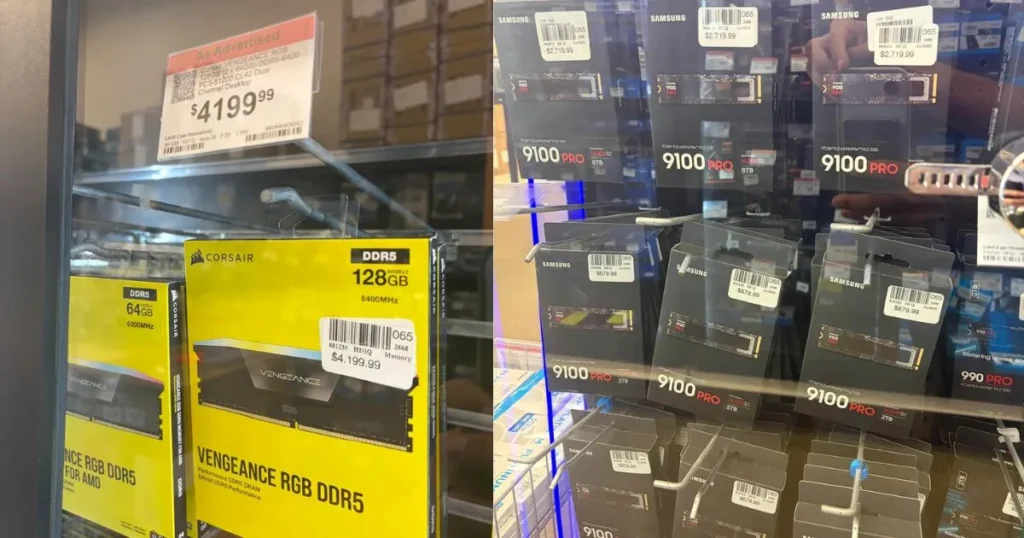
Redditor Hell-Diver7 shared images from a Micro Center location showing display cases fully stocked with DDR5 memory kits and high-end NVMe SSDs. There is no emptiness. No bare shelves. The products are there, ready to be bought. The catch? The price tags attached to them are astronomical.
Price Tags That Raise Eyebrows
One photo shows a Corsair Vengeance RGB 128GB DDR5-6400 kit priced at $4,199.99. Another shows Samsung’s 9100 PRO 8TB SSD at $2,719.99, while the 2TB version is labeled $679.99. For context, a high-end 2TB PCIe 5.0 SSD typically sells for $200–300, and a 128GB DDR5 kit—while expensive—rarely approaches four thousand dollars outside of workstation-specific modules.
Some Redditors familiar with Micro Center’s pricing noted that in-store tags are not always accurate and that online listings often show lower, more realistic prices. Still, the disconnect between “shortage” rhetoric and full shelves is striking.
Analysts vs. Reality
Most analyst firms agree that memory price hikes may continue through 2026 and into 2027, driven by AI’s insatiable appetite for DRAM and NAND. OpenAI alone has reportedly signed letters of intent for hundreds of thousands of wafers per month. That narrative has pushed memory stocks higher and justified sustained price increases.
But retail inventory tells a different story. If shelves are full of high-end memory and storage, demand from consumers may be weakening at current price levels. Gamers and PC builders are balking at $4,200 memory kits and $2,700 SSDs. They are waiting, or buying less, or sticking with older hardware.
Also, Read
- AMD Ryzen 9 9950X3D2 Retail Listings Appear Ahead of April 22 Launch, But Those Prices Are Likely Placeholders
- Radeon RX 9070 XT Returns to Effective $699 Pricing—But Only With Bundled Extras
- Intel Nova Lake-S Rumor: Dual-Tile Desktop CPU Gets Bumped from 42 to 44 Cores
What Happens Next?
The gap between analyst forecasts and retail reality suggests a potential market correction. If inventory continues to build while demand stays weak, retailers may be forced to lower prices—regardless of what AI data centers are paying. The memory shortage may be real at the contract level, but consumer retail is a different beast.
For now, the photos from Micro Center serve as a visual reminder: a shortage only exists when products are unavailable. When shelves are full but prices are too high, that is not a shortage—it’s a pricing problem. And pricing problems tend to solve themselves when buyers walk away.