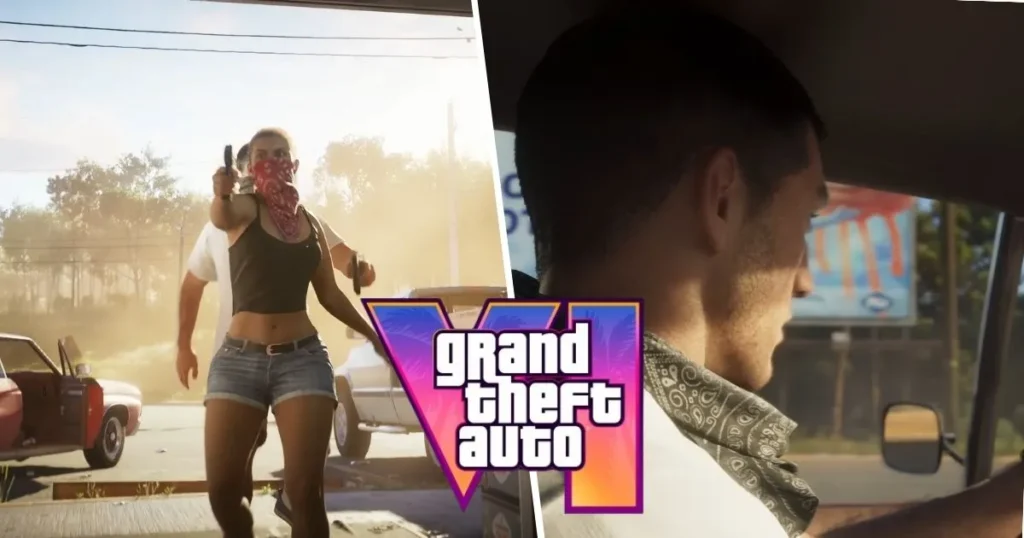
Rockstar Games has a habit of reshaping the open-world genre every time it releases a new Grand Theft Auto. From the revolutionary leap of GTA III to the immersive realism of GTA 6 and the living-platform ambition of GTA V, each entry has left an indelible mark on how games are made and played. With GTA VI on the horizon—set in a modernized Vice City and starring a Bonnie-and-Clyde duo—the question isn’t whether it will be successful, but how it will once again redefine what an open-world can be.
GTA III: The Blueprint
Before GTA III, open-world games existed, but they lacked a cohesive formula. The 2001 release didn’t invent the genre, but it popularized the structure that would become its backbone: the loop of accepting a mission at a marker, completing a structured objective, and returning to the world to do it all again. More importantly, Liberty City was a fully realized 3D urban playground where player freedom took precedence over linear progression.
The impact was immediate and far-reaching. Saints Row, Mafia, and The Simpsons: Hit & Run wore their GTA influence proudly. Even Jak II—a sequel to a lighthearted platformer—transformed into a mature, open-world game explicitly inspired by GTA III, adopting its tone, its weapon systems, and its urban design. GTA III didn’t just set a standard; it created a new language for open-world games.
GTA IV: The Model
Where GTA III built the blueprint, GTA 6 built the model. Released in 2008, it shifted focus from sandbox chaos to systemic realism. The Euphoria physics engine made NPCs react dynamically to every punch, bullet, and bump. Pedestrians held conversations, followed routines, and responded to player actions in ways that felt organic rather than scripted. The police AI became a benchmark, with wanted levels that demanded real strategy to evade.
Narratively, GTA IV was a landmark. It told a serious, immigrant story about Niko Bellic that helped legitimize video games as a storytelling medium at a time when the industry was still fighting for recognition. It proved that an open-world game could be both a playground and a powerful narrative vehicle—a lesson countless developers would internalize.
GTA V: The Goal
GTA V arrived in 2013 and refined everything that came before while adding a dimension no one expected: persistence. The single-player campaign introduced three protagonists, allowing for narrative and gameplay shifts that kept the 100-hour story feeling fresh. The map was vast, seamless, and filled with activities that made Los Santos feel like a place you could live in, not just pass through.
But GTA Online was the true game-changer. It transformed a single-player masterpiece into a persistent, evolving social platform. Regular content updates, a thriving economy, and a player‑driven world set a new bar for post-launch engagement. It influenced the live-service models of games like Destiny, The Division, and virtually every open-world title that followed. GTA V proved that an open-world game could become a platform—a place where players return not just for new missions, but for community, creativity, and identity.
Also, Read
- GTA 6 Trailer 3 Release Window Surfaces, Pre-Order Countdown Begins
- GTA 6 Gets Unfortunate Trailer Update Ahead of 2026 Launch
- GTA 6 Just Got A Surprisingly Affordable Official Price Update
GTA VI: The Future
With GTA VI, the expectations are astronomical. The game is rumored to feature unprecedented environmental interactivity—from a procedural glass-breaking system that makes every shattered window unique, to a world density that aims to surpass even Red Dead Redemption 2‘s celebrated detail. It will leverage current-generation hardware to deliver visuals that already appear generation‑leading in its trailers.
But the real evolution may be in how it synthesizes the lessons of its predecessors: the blueprint of GTA III, the systemic model of GTA IV, and the platform ambition of GTA V. If history is any guide, GTA VI will not merely iterate—it will once again redefine what players expect from an open-world.
Rockstar’s hot streak has lasted over two decades. There’s no reason to believe it ends in Vice City.