NVIDIA Assures Gamers: DLSS 5 Won’t Override Your Favorite Game’s Art Style
Following the dramatic unveiling of DLSS 5 at GTC 2026, NVIDIA is moving quickly to address one of the most prominent concerns raised by the gaming community: the fear that AI-driven neural rendering might fundamentally alter or erase the carefully crafted artistic direction of beloved games.
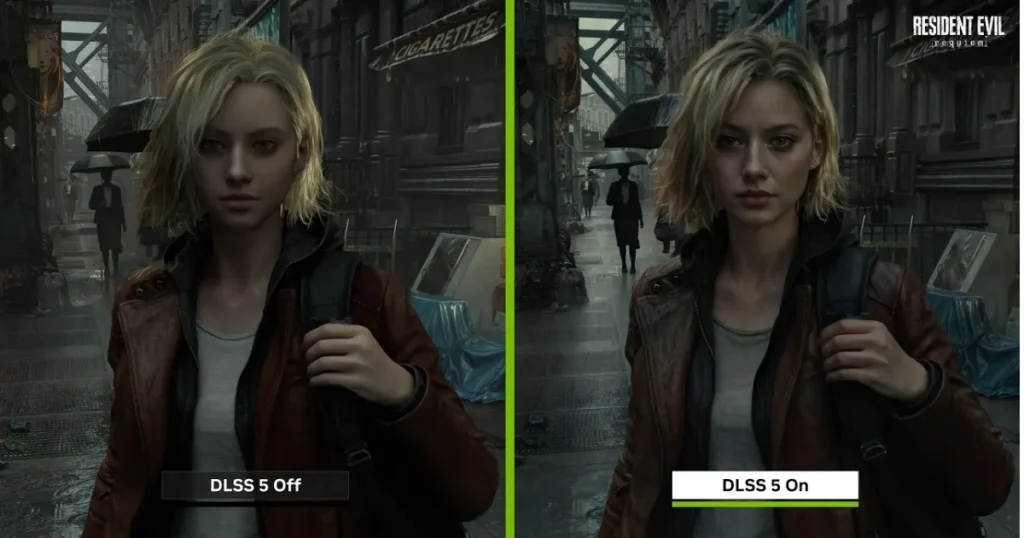
In a detailed technical briefing, the company emphasized that DLSS 5 is designed as a guided rendering tool, not a one-size-fits-all filter. While early demonstrations showed significant visual changes—in some cases altering character faces nearly beyond recognition—NVIDIA insists that the final technology places control firmly in the hands of developers.
How DLSS 5 Honors Artistic Intent
According to NVIDIA, the system preserves creative vision through two primary mechanisms. First, DLSS 5 takes each frame’s color data and motion vectors as direct input, anchoring its output firmly to the source 3D content rather than generating imagery without reference to the game’s original rendering data.
Second, and perhaps more importantly, the technology ships with an extensive suite of developer controls. Game artists and engineers can tune:
- Intensity – How strongly the neural enhancement is applied
- Color grading – Adjustments to blending, contrast, saturation, and gamma
- Masking – The ability to exclude specific objects or entire image regions from enhancement entirely
This means a developer could, for example, apply photorealistic lighting to environmental elements while preserving a stylized, hand-painted look for character faces if that suits the game’s aesthetic.
The Benefits: Cinematic Quality Without Compromise
NVIDIA outlined several key advantages of the DLSS 5 approach:
- Cinematic Lighting: The system can reconstruct complex effects like rim lighting, subsurface scattering for realistic skin, and contact shadows with high fidelity
- Material Depth: Enhancement of PBR (Physically Based Rendering) properties, including roughness, and added micro-realism to complex objects such as eyes and hair
- Temporal Consistency: Stable image quality from frame to frame that adheres to the underlying game content
- Real-Time Performance: Photorealistic enhancement at up to 4K resolution while maintaining smooth, interactive gameplay
The Elephant in the Room: Why Faces Looked So Different
The company’s assurances come in response to widespread community feedback noting that characters in demonstration footage appeared dramatically altered. In some cases, faces took on what critics described as a “generic AI aesthetic” bearing little resemblance to the original character models.
NVIDIA’s explanation is twofold. First, the demonstrations were early showcases of the technology’s capabilities, not final implementations tuned by developers. Second, the company argues that what some viewers perceived as “different” is actually the result of adding subsurface scattering and more accurate light interaction—effects that were computationally impossible in real-time before DLSS 5.
The key distinction is that in a shipping game, a developer could dial these effects back or mask them entirely if they conflict with the intended art direction.
What This Means for Gamers
For end users, the most important takeaway may be the simplest: you can turn it off. Like all DLSS features, DLSS 5 will be optional. Gamers who prefer the original, unenhanced look of their favorite titles can simply disable the technology in supported games.
However, for those who choose to enable it, the visual uplift promises to be substantial. The combination of cinematic lighting, enhanced materials, and temporal stability could make games look closer to Hollywood CGI than ever before—while preserving the artistic choices that made them unique.
Hardware Requirements Remain Unclear
NVIDIA has yet to confirm which GPU architectures will support DLSS 5. The GTC demonstration required two RTX 5090 cards—one running the game, the other dedicated exclusively to DLSS 5 processing—though the company maintains that the final consumer version will be optimized for single-GPU operation.
Given the computational demands, DLSS 5 is expected to be primarily a GeForce RTX 50 Series feature, leveraging the advanced Tensor Cores of Blackwell architecture. Support for older generations, if any, will likely be limited.
Also, Read
- NVIDIA Unveils DLSS 5 with Neural Rendering – A “GPT Moment” for Graphics Arriving This Fall
- NVIDIA’s Ambitious Vision – Future GPUs Target 1,000,000x Path Tracing Leap Over Pascal
- NVIDIA Confirms DLSS 4.5 Dynamic Multi Frame Generation Arrives March 31
The Bottom Line
DLSS 5 represents a bold bet on AI’s role in gaming’s visual future. By giving developers granular control while offering players the option to opt out, NVIDIA hopes to navigate the delicate balance between technological advancement and artistic preservation.
Whether the community embraces the results or continues to push back against AI-augmented aesthetics will likely depend on how skillfully developers wield these new tools in the first wave of DLSS 5 titles arriving this fall.
Source: NVIDIA