NVIDIA’s DLSS 5 Marks a New Era: Neural Rendering Brings Hollywood Visuals to Real-Time Gaming
At its GTC 2026 conference, NVIDIA unveiled DLSS 5, a technology the company calls the most significant breakthrough in computer graphics since the introduction of real-time ray tracing in 2018. Unlike previous versions focused primarily on boosting frame rates, DLSS 5 represents a fundamental shift toward using AI to dramatically enhance visual fidelity.
NVIDIA CEO Jensen Huang described the launch as “the GPT moment for graphics — blending handcrafted rendering with generative AI to deliver a dramatic leap in visual realism while preserving the control artists need for creative expression”. The technology is scheduled to arrive in fall 2026.
What Makes DLSS 5 Different?
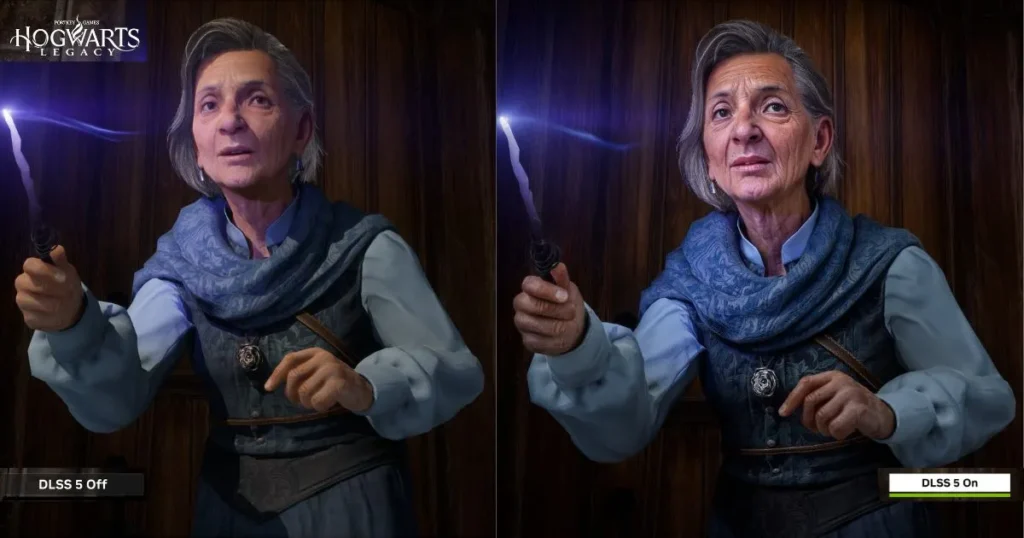
DLSS 5 introduces a real-time neural rendering model that fundamentally changes how game frames are processed. Rather than simply upscaling images or generating additional frames, the system takes each frame’s color data and motion vectors, then applies an AI model trained to understand scene semantics—identifying elements like skin, hair, fabric, and complex lighting conditions.
The result is pixel output enhanced with photorealistic lighting and material responses that remain anchored to the original 3D scene. The system operates in real time at up to 4K resolution while maintaining frame-to-frame consistency, a critical requirement for gaming applications.
Early demonstrations show dramatic improvements in subsurface scattering on skin, realistic fabric sheen, and accurate light interaction with hair—effects previously achievable only in offline Hollywood visual effects pipelines.
The Technology Behind the Leap
According to Digital Foundry’s early analysis, DLSS 5 represents a “graphics revolution” where AI models effectively “bypass” years of traditional hardware evolution to deliver photorealistic lighting on existing architectures. The technology builds on the foundation of DLSS 4.5, which can already infer 23 out of every 24 pixels on screen.
However, the computational demands are significant. NVIDIA’s GTC demonstration required two RTX 5090 GPUs—one running the game, the other dedicated exclusively to DLSS 5 processing. The company has confirmed that the final consumer version will be optimized to run on a single GPU when it launches later this year.
Industry-Wide Support
DLSS 5 has garnered unprecedented backing from major publishers and developers. Bethesda, CAPCOM, Ubisoft, Warner Bros. Games, Tencent, and NetEase have all committed to integrating the technology.
The first wave of confirmed titles includes an impressive lineup:
- Starfield – Bethesda’s space epic
- Assassin’s Creed Shadows – Ubisoft’s upcoming historical adventure
- Resident Evil Requiem – The next chapter in CAPCOM’s horror franchise
- Hogwarts Legacy – The Wizarding World RPG
- The Elder Scrolls IV: Oblivion Remastered – The classic returns
- Delta Force, NARAKA: BLADEPOINT, and more
Bethesda’s Todd Howard expressed enthusiasm after seeing DLSS 5 running in Starfield: “It was amazing how it brought it to life”.
Developer Control and Artistic Intent
Despite the AI-driven enhancements, NVIDIA has emphasized that DLSS 5 is designed with artist control as a priority. Developers receive granular controls for intensity, color grading, blending, contrast, saturation, and gamma adjustments. They can also apply masking to exclude specific objects or regions from enhancement, preserving a game’s unique aesthetic vision.
This addresses concerns that AI-generated visuals might override intentional art direction. The technology integrates through NVIDIA’s existing Streamline framework, already used for DLSS and Reflex, minimizing developer adoption friction.
Hardware Requirements and Availability
DLSS 5 is designed primarily for GeForce RTX 50 Series GPUs, leveraging the latest Tensor Core technology in Blackwell architecture for AI processing. While NVIDIA hasn’t confirmed support for older architectures, the computational demands suggest the best experience will require current-generation hardware.
The technology is scheduled for release in fall 2026, with an exact date yet to be announced. NVIDIA plans to integrate DLSS 5 deeply with frame generation options, as each frame in supported titles will essentially be AI-rendered.
Mixed Early Reactions
While industry support has been strong, early community reactions show some skepticism. Forum discussions have raised concerns about an “AI slop” aesthetic, with some players feeling that character faces in demonstrations took on an artificial, uncanny quality . Others worry that aggressive AI enhancement might compromise original artistic intent.
However, proponents note that DLSS 5 is a tool for developers to implement selectively, not an automatic filter applied to all games. As one commenter observed, “Devs can now save a ton of money on modeling faces since they’ll be copied over with generic AI sex dolls” captured the dismissive tone of some critics, while others countered that the technology’s potential will become clearer as developers learn to wield it effectively.
Also, Read
- NVIDIA’s Ambitious Vision – Future GPUs Target 1,000,000x Path Tracing Leap Over Pascal
- NVIDIA Confirms DLSS 4.5 Dynamic Multi Frame Generation Arrives March 31
- NVIDIA Rumored to Launch GeForce RTX 5050 with 9GB GDDR7 and 96-Bit Bus
The Bottom Line
DLSS 5 represents a bold bet on AI’s role in gaming’s visual future. By shifting computational effort from brute-force rendering to intelligent enhancement, NVIDIA aims to bridge the gap between real-time interactivity and cinematic quality. Whether players embrace the results or push back against an AI-augmented aesthetic will likely shape the next decade of PC graphics.
Source: NVIDIA