NVIDIA’s Dominance Reaches New Heights: 94% Market Share Leaves AMD and Intel in the Dust
The latest market analysis from Jon Peddie Research (JPR) paints a stark picture of the desktop graphics card landscape. In the fourth quarter of 2025, NVIDIA solidified its iron grip on the add-in-board (AIB) GPU market, capturing an unprecedented 94% share. This represents a 1.6 percentage point increase from the previous quarter and a staggering 10-point jump compared to the same period in 2024.
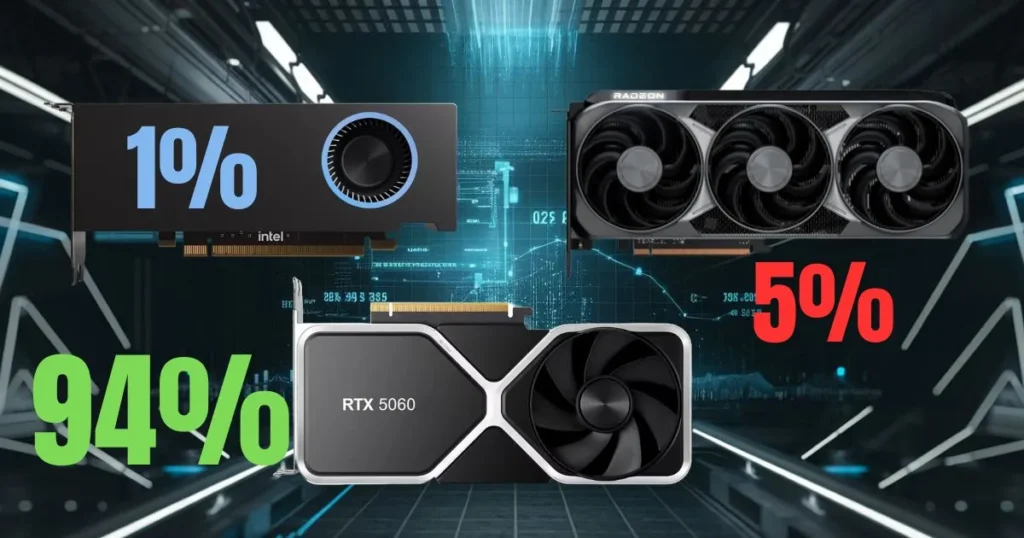
The numbers leave little room for interpretation. AMD’s share fell by the same margin that NVIDIA gained, dropping 1.6 points to end the quarter at just 5% —a dramatic decline from the 15% the company held just one year earlier. Intel, despite its ambitions in the discrete GPU space with its Arc series, remained flat at 1%, unable to gain meaningful traction.
Total AIB shipments for Q4 2025 reached 11.48 million units, a 4.4% decline from the previous quarter. This drop significantly underperforms the historical average of 10.82% growth typically seen in fourth quarters, signaling underlying market weakness. However, the year-over-year comparison shows a robust 36% increase, reflecting the industry’s recovery from the previous year’s product launch lulls.
The Squeeze on Desktop Graphics
JPR attributes the quarterly contraction to familiar but intensifying pressures: skyrocketing memory costs and the impact of tariff policies. DRAM and NAND prices, driven by insatiable AI data center demand, have pushed the cost of graphics cards higher, suppressing consumer appetite.
Jon Peddie, president of Jon Peddie Research, explained the dual challenge facing the market: “The AIB market, primarily driven by gamers, is being squeezed from below by high-performance notebooks and integrated graphics solutions, and from above by rising prices due to supply-demand dynamics, memory costs, and tariff uncertainty”. This environment has led many potential upgraders to adopt a wait-and-see approach, further dampening sales.
The desktop AIB attach rate fell to 55%, a drop of 12.3% from the prior quarter, even as desktop CPU shipments rose to 21.0 million units. This disconnect suggests that while people are buying PCs, they are increasingly opting for systems without discrete graphics—a troubling sign for the dedicated GPU market.
GPUS Prices
A Bleak Forecast
Looking ahead, JPR’s outlook is sobering. The firm projects that the combined pressures of high prices and economic uncertainty could push the PC and AIB market down by nearly 10% in 2026. Over the longer term, the forecast is equally challenging: a negative compound annual growth rate of -5.9% for AIBs through the forecast period (2024-2028), with the installed base expected to reach 172 million units by the end of that window.
Also, Read
- AMD Zen 6 Desktop “Olympic Ridge” Ryzen CPUs Reportedly Slip to 2027 Launch
- Intel Core Ultra 400 “Nova Lake-S” Desktop Reportedly Arrives at CES 2027 Alongside AMD Zen 6
- Hard Drive Prices So Bad, UK Data Hoarder Flies to US to Buy Storage—Still Saves $2,000
For AMD and Intel, the path forward appears steep. While AMD’s RDNA 4 architecture launched earlier this year, supply constraints and a strategic focus on the mid-range segment have failed to meaningfully shift the needle. Intel’s Arc GPUs have shown stable demand, but breaking out of single-digit market share will likely require more compelling product designs, potentially with the anticipated “Battlemage” series.
For now, NVIDIA stands alone at the summit, its position seemingly unassailable even as the market beneath it shows signs of strain.
Source: jonpeddie