NVIDIA’s Entry-Level Shuffle: RTX 5050 Rumored to Get 9GB GDDR7, 96-Bit Bus
NVIDIA’s GeForce RTX 50 series may be getting a quiet but notable update at the entry level. According to reliable leaker MEGAsizeGPU, the company is planning a revised version of the GeForce RTX 5050 that swaps out the current memory configuration for something entirely new: 9GB of GDDR7 on a 96-bit bus.
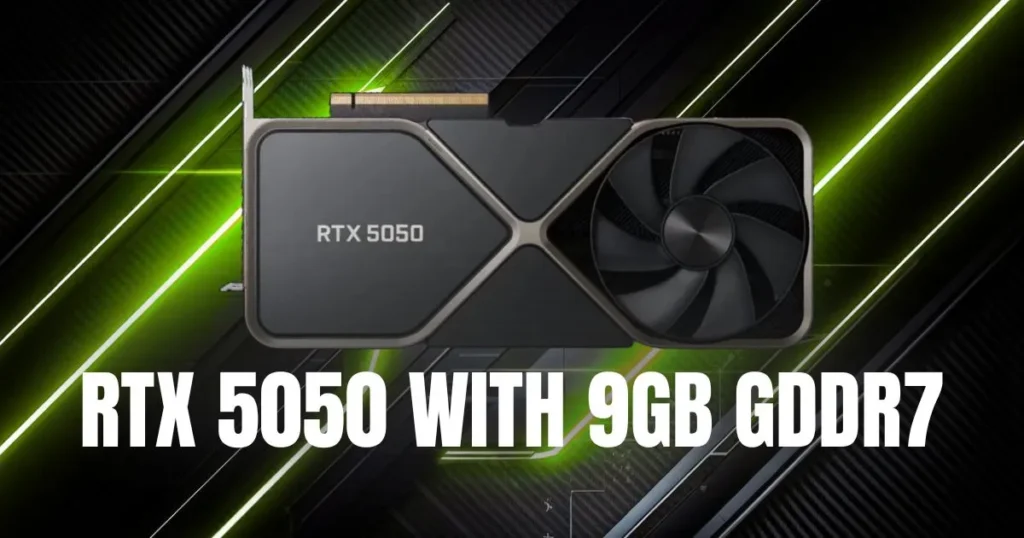
The move represents an unconventional approach to refreshing the lowest-tier Blackwell desktop GPU, and it appears to be driven by supply dynamics rather than a desire for a straightforward performance upgrade.
Specs: Smaller Bus, Faster Memory, Slightly More Bandwidth
The current RTX 5050 ships with 8GB of GDDR6 memory running at 20 Gbps across a 128-bit interface, delivering 320 GB/s of bandwidth. It is the only card in the RTX 50 desktop lineup still using GDDR6.
The rumored revision would replace the four 2GB GDDR6 modules with three 3GB GDDR7 modules. This configuration reduces the memory bus to 96-bit but compensates with faster 28 Gbps GDDR7 memory. The result is a total bandwidth of approximately 336 GB/s—a modest 5% increase over the current model—along with a 12.5% bump in capacity to 9GB.
Core specifications are expected to remain unchanged. The card will likely retain the same GB207 GPU with 2,560 CUDA cores and a 130W power target. This suggests NVIDIA is treating this as a mid-cycle materials substitution rather than a performance-tier adjustment.
Why the Change?
The timing and nature of this update point to supply chain pressures. GDDR6 availability has reportedly become constrained, while NVIDIA has access to 3GB GDDR7 modules already used in workstation cards and the mobile RTX 5090. Rather than let those modules sit idle, the company appears to be routing them into the entry-level desktop stack.
There is also a strategic element: a 9GB RTX 5050 carves out a clearer distinction between the entry-level card and the RTX 5060, which retains 8GB on a 128-bit bus. A hypothetical 12GB RTX 5050 with a full 128-bit interface would arguably compete too closely with the tier above.
New product: RTX5050 9GB GDDR7 96Bit
— MEGAsizeGPU (@Zed__Wang) March 4, 2026
NV knows they can give you a 5050/5060 128-bit 12G with the new 3G GDDR7 dies. But no, you got a 5050 9G💀
RTX 5060 Also Getting a Quiet Update
The RTX 5050 isn’t the only card seeing adjustments. According to the same leaker, NVIDIA is also preparing an alternative version of the GeForce RTX 5060 that uses a heavily cut-down GB205 GPU—the same chip found in the RTX 5070—rather than the usual GB206.
This change is reportedly driven by a mismatch in chip supply. NVIDIA allocated too many GB205 chips to RTX 5060 Ti 8GB production, leaving insufficient GB206 dies for the standard RTX 5060. The solution is to disable large portions of the GB205 to match the RTX 5060’s 3,840 CUDA core count and 128-bit memory interface.
RTX5060 GB205 incoming
— MEGAsizeGPU (@Zed__Wang) March 4, 2026
NV has jammed AIC with 5060Ti 8G, and later realized Oh shit, no GB206 for 5060. And here comes the solution: 5060 based on GB205. Poor AICs need to make a new 5060 PCB design to house the GB205. Basically making a 5070 PCB with an 8-pin connector.
Board partners will need to adopt new PCB designs similar to those used for RTX 5070 cards, and the revised RTX 5060 will reportedly use a standard 8-pin PCIe power connector.
What This Means for Buyers
For consumers, the updates are unlikely to change purchasing decisions dramatically. The revised RTX 5050 offers slightly more memory and marginally higher bandwidth at what will hopefully remain a similar price point. The extra 1GB could prove useful in memory-constrained scenarios, though the 96-bit bus remains a potential bottleneck.
Also, Read
- Go Big or Go Home – LG’s Massive 52-Inch 5K2K 240Hz Monitor is Now Available for Pre-Order
- Intel Core X HEDT Returns – 52-Core Nova Lake-S Rumored to Demand New Socket and Beefier Motherboards
- MSI’s Yellow-Tipped 16-Pin Connector Reportedly Works Itself Loose, Increasing Burn Risk
The RTX 5060 update is essentially a supply-driven substitution with identical specs, so performance should be unchanged. However, the cancellation of the rumored RTX 5060 12GB model—which had appeared in earlier roadmaps—suggests NVIDIA is prioritizing supply stability over capacity increases in this generation.
Both revisions are expected to roll out gradually, possibly with limited regional availability rather than a global launch event. As always with pre-release rumors, specifications remain unconfirmed until official announcement.
Source: Zed__Wang