At Mobile World Congress 2026, AMD officially expanded its Ryzen AI portfolio to the desktop, introducing the Ryzen AI 400 Series and Ryzen AI PRO 400 Series processors. These chips mark a significant milestone as the world’s first desktop processors designed to support Microsoft’s Copilot+ PC experiences, thanks to a dedicated neural processing unit (NPU). However, for enthusiasts hoping for a desktop version packing the most powerful integrated graphics, the news comes with a notable caveat.
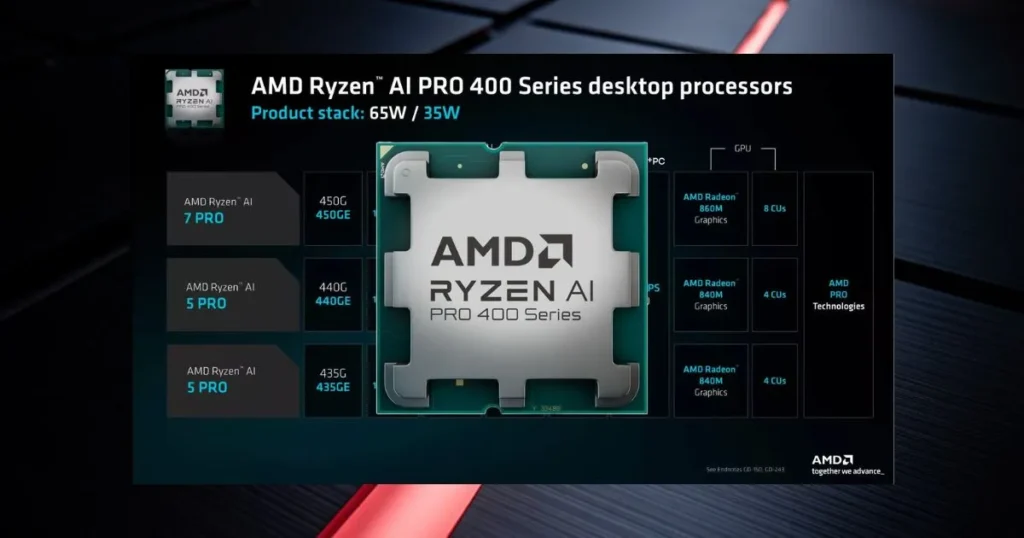
First Desktop AI Processors for AM5
The new processors are built on the “Zen 5” architecture and feature an XDNA 2 NPU capable of up to 50 TOPS (trillion operations per second) of AI compute, far exceeding the requirements for next-generation AI PC features. They are designed as successors to the Ryzen PRO 8000G series and fit into the existing AM5 socket, making them compatible with 600- and 800-series motherboards.
The lineup consists of six SKUs, split into 65W “G” models and more power-efficient 35W “GE” variants for compact and mini PCs. At the top of the stack is the Ryzen AI 7 450G/450GE, an 8-core, 16-thread processor with a 5.1 GHz boost clock, 24MB of cache, and an XDNA 2 NPU. Below it are two 6-core, 12-thread Ryzen AI 5 parts with varying cache sizes.
A Surprising Graphics Cutback
While the new APUs integrate RDNA 3.5-based Radeon graphics, the configuration is notably scaled back. The highest-tier iGPU available is the Radeon 860M, which features only 8 compute units (CUs) . This is a significant reduction from the top-tier mobile “Strix Point” chips, which utilize the Radeon 890M with 16 CUs and offer substantially higher graphics performance.
The mid-range Ryzen AI 5 models are paired with the Radeon 840M, which has just 4 compute units. For context, the 890M has proven to be a capable 1080p gaming solution in laptops, but the 860M will offer a more modest level of graphical horsepower. There is no desktop variant that matches the 16-CU 890M found in high-end mobile parts.
Positioning and Availability
AMD is positioning these new processors squarely at the commercial and mainstream desktop market rather than the DIY enthusiast segment. The emphasis is on enabling on-device AI for productivity, security, and manageability in business environments, backed by the AMD PRO platform.
“With the Ryzen AI 400 Series processors – the world’s first designed to power new Copilot+ experiences on the desktop – we’re bringing powerful AI acceleration that enables our partners to build systems that empower both enterprises and consumers to do more and create more,” said Jack Huynh, senior vice president at AMD.
Also, Read
- AMD Zen 6 Desktop “Olympic Ridge” Ryzen CPUs Reportedly Slip to 2027 Launch
- TAMD Zen 6 “Olympic Ridge” Ryzen CPUs Rumored to Pack Up to 24 Cores Across Seven Configurations
- Radeon RX 9000 Prices Tumble in Japan as Gamers Rebel Against High GPU Costs
For consumers hoping to build their own systems, the news is mixed. While non-PRO variants exist with nearly identical specs, the primary launch channel appears to be through OEMs. The first desktop systems from partners like HP and Lenovo are expected to arrive in Q2 2026. Whether these chips will see widespread retail availability as boxed processors remains unconfirmed.
For users who primarily need strong CPU performance and leading-edge NPU capabilities for AI workflows, the Ryzen AI 400 series offers a compelling new option on the AM5 platform. But for those hoping to build a powerful compact gaming rig using just integrated graphics, the wait for a high-CU desktop APU continues.
Source: AMD