When Hard Drive Prices Get This Crazy, You Book a Flight
For most people, the words “I need more storage” lead to a quick online order and a delivery a few days later. For a dedicated member of the Reddit community r/DataHoarder, those words led to a transatlantic flight, a budget hotel in New York City, and a carefully orchestrated plan to carry ten 28-terabyte hard drives home in his carry-on luggage.
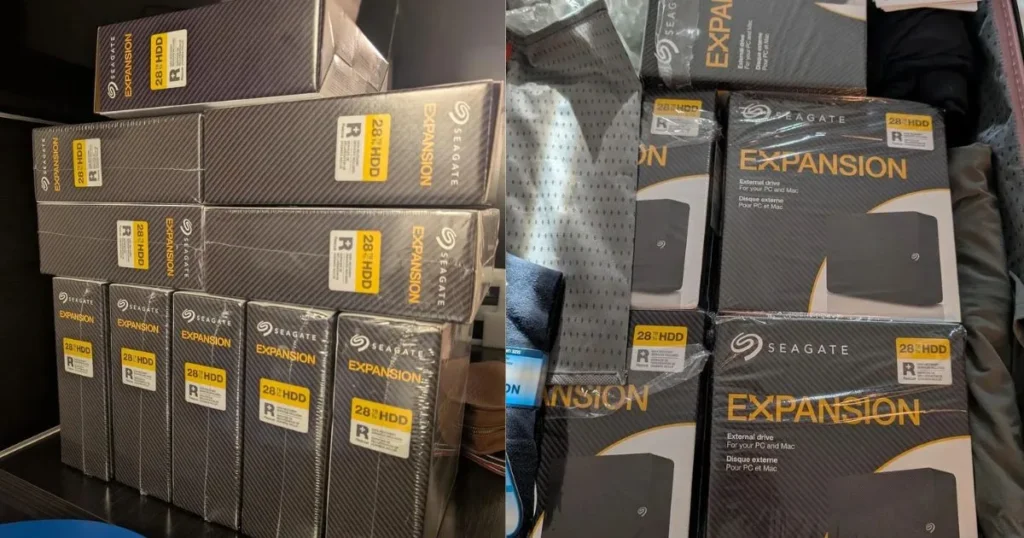
The user, posting as cgtechuk, faced a reality familiar to anyone buying high-capacity storage outside the United States: the price gap has become absolutely staggering. After running the numbers, he discovered that flying from the UK to New York, buying the drives in person, paying import VAT, and flying back was still significantly cheaper than buying the same drives at home.
The Math That Made It Make Sense
The numbers tell the story. In the US, the Redditor paid approximately £244 per drive (around $310 USD at current exchange rates). After purchasing ten drives, he declared them at customs and paid the required 20% import VAT, bringing the effective cost per drive to about £293.
In the UK, the same retail 28TB drives were selling for approximately £568 each. Even “server recertified” units—used or refurbished drives with less warranty coverage—were listed between £420 and £450.
The per-drive gap between US retail plus VAT and UK retail was roughly £275. Multiply that by ten drives, and the gross savings approached £2,750 (approximately $3,700 USD). That left plenty of room to cover a last-minute flight, a few nights in a budget hotel, meals, and ground transportation—and still walk away with roughly $2,000 in net savings.
The Logistics: Not for the Faint of Heart
Executing this plan required more than just a credit card and a passport. The user discovered that US retailers had purchase limits, capping sales at five drives per store. This meant splitting the acquisition across two different retailers to secure all ten units.
To protect against the risk of receiving swapped merchandise or incorrect capacities, the Redditor documented everything. He filmed the pickup process at each store and carefully recorded serial numbers at the time of purchase. Then came the most critical step: before flying home, he tested every single drive in his hotel room using diagnostic tools and file copy tests to ensure they were functional and free of defects.
Packing presented another challenge. Bare hard drives are fragile and sensitive to physical shock. The user brought foam inserts specifically designed to protect the drives, allowing him to pack them securely in his carry-on luggage for the flight home. The original packaging, presumably bulky and conspicuous, was checked separately.
Declaring and Paying
Importantly, the user did not attempt to evade taxes or duties. He declared the drives upon return to the UK and paid the required 20% import VAT using the invoices from his US purchases. This transparency adds legitimacy to the comparison: even with full legal compliance, the savings remained substantial.
Why Such a Huge Price Gap?
The disparity highlights a broader issue in the global hard drive market. High-capacity drives—particularly those above 20TB—have seen significant price inflation due to a combination of factors: ongoing demand from data centers and AI infrastructure, limited manufacturing capacity, regional distribution costs, and perhaps most importantly, simple market segmentation where manufacturers charge whatever local markets will bear.
The UK market, with its smaller population and higher logistics costs, has been hit particularly hard. Meanwhile, US consumers benefit from a larger, more competitive retail environment and closer proximity to manufacturing and distribution hubs.
The Risks and Rewards
The Redditor’s approach demonstrates both the extremes that data hoarders will go to for storage and the risks they’re willing to assume. A single damaged drive during transit could wipe out a significant portion of the savings. A customs inspection that insisted on different valuation could add unexpected costs. A hotel room test that revealed DOA units would require returns to US stores after the purchaser had already left the country.
None of those worst-case scenarios materialized. The drives tested good, the flights connected, and the savings held.
Also, Read
- RTX 5090 Burns Even at 500W – User’s Power Cap Fails to Prevent Melted Adapter
- User Claims ASUS Motherboard Killed Two Ryzen X3D Chips—Including a Replacement 9850X3D
- Phison CEO Warns of “Massive Die-Off” Among Consumer Electronics Companies by End of 2026
The Bottom Line
“TLDR: UK prices for 28TB drives was so bad it was cheaper to fly to the US, buy them and bring them home,” the user summarized.
For the r/DataHoarder community, the story is both a cautionary tale and an inspiration. It speaks to the lengths enthusiasts will go to preserve their digital collections, and it underscores just how distorted the global storage market has become.
And on the bright side: the user now has 280 terabytes of fresh storage and a story that will last even longer than the drives.
Source: Reddit