The price inflation for NVIDIA’s flagship graphics card has reached a paradoxical new extreme. Market analysis reveals that purchasing a standalone GeForce RTX 5090 graphics card now costs nearly the same as buying an entire prebuilt gaming desktop that includes the RTX 5090, along with a CPU, motherboard, memory, and all other components.
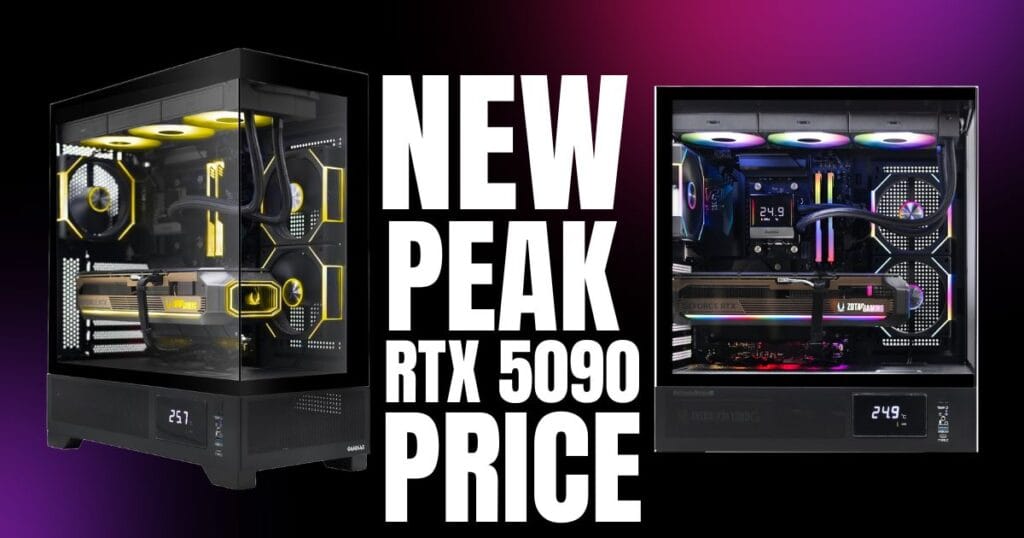
This bizarre pricing dynamic turns conventional upgrade logic on its head, suggesting that for many buyers, the most cost-effective way to acquire the world’s most powerful consumer GPU might be to purchase a complete system built around it.
The Stark Numbers: GPU vs. Full System
A survey of major U.S. retailers shows the stark reality. While NVIDIA’s official MSRP for the RTX 5090 remains $1,999, that price is virtually mythical outside of its exclusive lottery-style “Verified Priority” program. Real-world, in-stock prices for standalone cards have ballooned.
- Standalone RTX 5090: The cheapest purchasable cards now start around $3,500, with many premium models listed between $3,900 and $4,000. Listings below $3,500 are often out of stock or from unauthorized marketplace sellers.
- RTX 5090 Prebuilt PCs: Complete gaming desktops featuring the RTX 5090 are readily found in the range of $4,400 to $4,700.
This narrow gap means the premium for the graphics card alone can be 80-100% of the cost of all other high-end components combined. For example, a ZOTAC MEK desktop with an RTX 5090, a Ryzen 7 9800X3D CPU, 32GB of RAM, and a 1300W power supply is listed at $4,499—a price that sits directly alongside listings for high-end custom RTX 5090 cards by themselves.
Why This Happens: The Retail vs. OEM Divide
This pricing anomaly is driven by fundamental supply chain economics. Large system integrators (OEMs) like ZOTAC, CyberPower, or iBUYPOWER purchase components like GPUs in bulk directly from manufacturers, often locking in pricing earlier and at better rates than retail distributors.
Furthermore, by selling a complete system, the OEM captures the profit margin that would normally be split between the GPU board partner, the distributor, and the retailer. This allows them to offer the sum of the parts for a price that competes with the outrageously inflated street price of the single most in-demand component.
ZOTAC MEK AI-Enhanced Gaming PC Desktop Computer – AMAZON
The Practical Takeaway for Buyers
For consumers, this creates a highly unusual decision matrix:
- The Hunt for MSRP: Attempting to win NVIDIA’s Founders Edition lottery is the only path to the $1,999 price, but odds are extremely low.
- The Overpay for an Upgrade: Buying a standalone card at $3,900 is difficult to justify when, for roughly $500-$800 more, you receive an entire top-tier computer.
- The Rational Choice: If you need a full system upgrade, buying an RTX 5090 prebuilt is arguably the most “sensible” way to acquire the GPU in today’s market.
Also, Read
- NVIDIA Reportedly Slashes GPU Supply by 20%, 2026 May See No New GeForce Cards
- NVIDIA RTX 5070 Ti Reportedly Discontinued, 16GB Models Become Scarce as Prices Soar
- NVIDIA’s RTX 50 Strategy – Prioritizing High-End Cards in Each Memory Tier Amid Shortages
This situation underscores the complete breakdown between MSRP and street price for halo products and highlights how, in times of extreme scarcity and demand, the traditional component market can become economically irrational, favoring bulk system purchases over individual upgrades.
Source: AMAZON